
Most 1099 seasons look like the one before them. This one does not.
The forms you file in early 2027 cover payments made during 2026, and almost every part of the process has moved: the dollar threshold, the boxes on the form, the system the IRS accepts electronic files through, and the penalty schedule. None of these changes is hard on its own. Together, they are enough to break a year-end process that has run the same way for a decade.
This is the practical guide for the 2027 filing season: what changed, what the dates are, and what to do between now and February.
What changed for the 2027 filing season
Five changes matter. In rough order of how many businesses they affect:
The threshold change has its own deep dive, including the state-by-state picture and the tax-year versus filing-year trap. The rest of this guide covers everything else.
The $2,000 threshold, in one paragraph
Payments you made between January 1 and December 31, 2026 are measured against $2,000. Pay a contractor $1,900 in 2026 and you do not file a 1099-NEC for them. Pay them $2,000 and you do. The forms you filed in January 2026 covered 2025 and correctly used $600, so there is nothing to amend.
A few thresholds did not move. Gross proceeds paid to an attorney stay at $600, royalties stay at $10, and if you withheld federal income tax from a payment, you file regardless of the amount. The threshold is indexed for inflation starting with 2027 payments. As of early November 2026 the IRS has not published the 2027 figure, and it does not affect the forms you file this season.
The new tip and overtime boxes
This is the change most likely to catch hospitality businesses off guard, because it is new territory, not a different number.
The One Big Beautiful Bill Act created income tax deductions for qualified tips and qualified overtime, and it added reporting requirements to support them. For tax year 2026, Forms 1099-NEC and 1099-MISC carry new boxes:
Form 1099-K gets matching boxes for cash tips and the occupation code.
Three things to get right:
- Tips are a subset, not an addition. The tip amount in box 1b is already part of the box 1a total. Do not add it on top.
- The occupation code matters to your contractor. Treasury published a list of occupations where people customarily receive tips, each with a three-digit code. The code tells the IRS whether the contractor's tips can count toward the tips deduction. Code 000 means the occupation is not on the list, and those tips do not qualify.
- The threshold still applies to the whole form. There is no separate tip threshold. If a contractor's total compensation is under $2,000, they get no 1099-NEC, tips included.
For a restaurant group or event company, the common case is a contract bartender, server, or event staffer who collected tips through your system and was paid them along with their fee. If you passed those tips through, you need to separate them in your payment records now. Rebuilding that split in January from bank statements is painful.
Box 1d is less common. Most payments to true independent contractors have no overtime component, and for most businesses the box will be empty. If you think you have contractors earning overtime, that is often a sign of a worker classification problem worth raising with your accountant.
FIRE is gone, IRIS is the only IRS e-file system
If you or your bookkeeper upload 1099 files directly to the IRS, the system is changing under you.
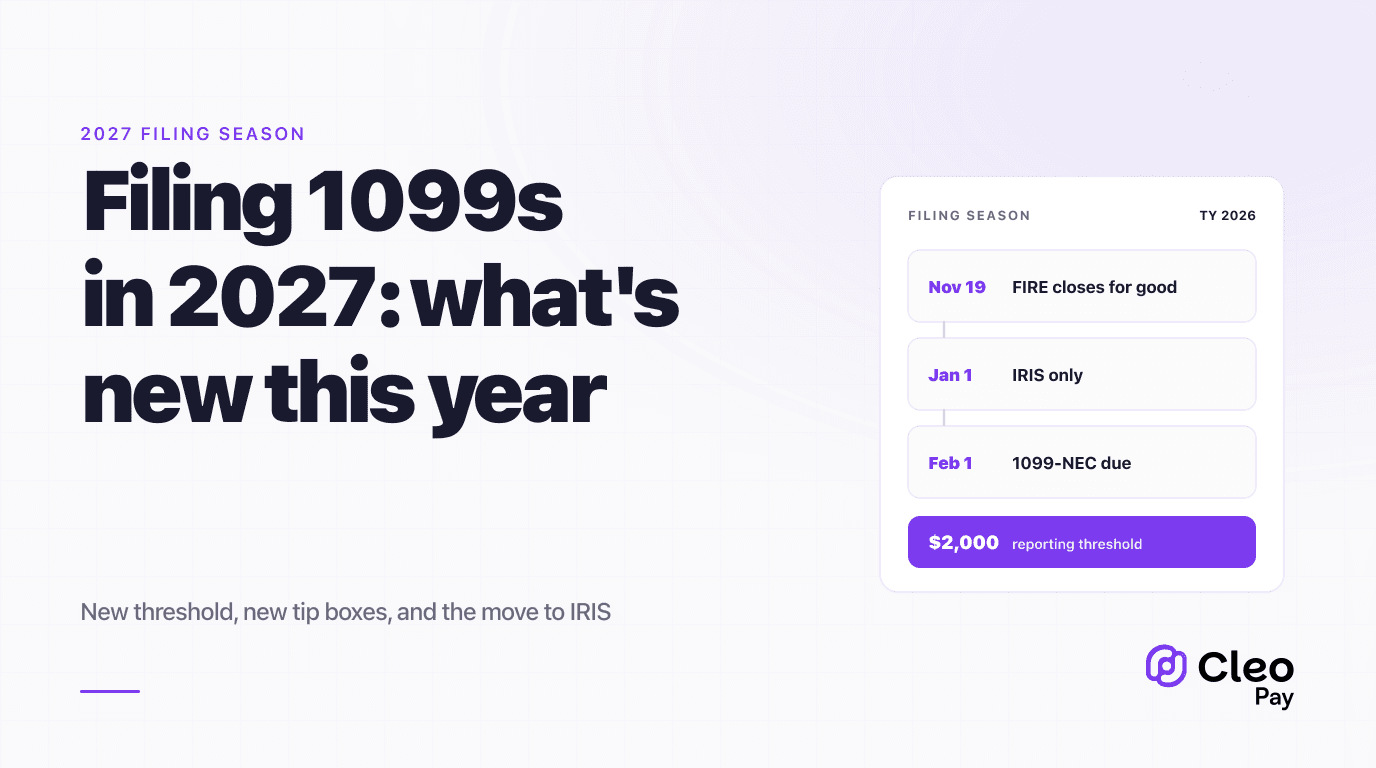
The IRS's Filing Information Returns Electronically system, known as FIRE, accepts its last submission on November 19, 2026, at 3 p.m. Eastern. From January 1, 2027, the Information Returns Intake System (IRIS) is the only IRS channel for electronically filing the 1099 series, according to the IRS. That includes corrections and prior-year returns.
What this means in practice:
- You need an IRIS Transmitter Control Code. A FIRE TCC does not carry over. Applications take time to approve, so apply now if you plan to file directly in January.
- IRIS has two ways in. The Taxpayer Portal is a web form you key returns into or upload a CSV to, which suits lower volume. The application-to-application (A2A) channel is for software that submits in bulk.
- Expect stricter validation. Errors that slipped through FIRE can cause IRIS to reject a submission. Clean names, TINs, and addresses before January, not after.
- E-filing is mandatory at 10 returns. If you file 10 or more information returns of any type in a year, counted together (1099s, W-2s, and others), you must file electronically.
If you use a filing service, payroll provider, or AP platform that files for you, most of this is their problem. Confirm with them that they have moved to IRIS.
2027 due dates
Several of the usual dates fall on weekends or holidays in 2027, so they move to the next business day.
* If you report amounts in 1099-MISC box 8 or box 10 (gross proceeds to an attorney), the recipient copy is due by Tuesday, February 16, 2027, because February 15 is Presidents' Day.
The 1099-NEC has no automatic extension. You can request one on Form 8809, but only for specific hardship reasons, and approval is not guaranteed. Plan to meet February 1.
Penalties for returns filed in 2027
Penalties are per form and apply twice: once for not filing correctly with the IRS, and again for not giving the recipient a correct copy. The amounts for returns due in 2027, from Rev. Proc. 2025-32:
Since the penalty applies to both the IRS copy and the recipient copy, a missed form can cost double the table amount. A restaurant group that never files for 30 contractors faces $340 times 30 times two, or $20,400, before interest.
Your filing timeline, starting now
There are about twelve weeks between today and February 1. Here is how to use them.
Now through mid-November. If you file directly, apply for your IRIS TCC. Pull year-to-date payments by vendor and flag anyone at or near $2,000. List every vendor without a W-9 on file.
Late November and December. Request missing W-9s while vendors are still responsive. Run TIN matching through IRS e-Services for anyone on the 1099 list. Separate passed-through tips from fees for tipped contractors, and record their occupation codes. Reconcile payments across locations, bank accounts, and card programs.
Early January. Close out December payments. Check entity types again, since most corporations do not get a 1099-NEC, with exceptions for legal and medical services. Generate draft forms and review them against your payment records.
Mid to late January. Fix any TIN mismatches. Deliver recipient copies and file with the IRS by Monday, February 1. Do not forget state filings where they apply.
After filing. Watch for IRIS acknowledgments and rejections, and correct quickly. The penalty is lowest within 30 days.
Don't forget 1099-K
If you take card payments, you will probably receive a Form 1099-K from your processor, not issue one. The same law restored the old 1099-K threshold for third-party settlement organizations like PayPal and Venmo: a form is required only when gross payments exceed $20,000 and the number of transactions exceeds 200. Card processors issue 1099-Ks for card payments regardless of volume.
For businesses that pay contractors, the old rule still applies: if you paid a contractor by credit card or through a payment app that issues 1099-Ks, those payments are reported on the 1099-K, and you leave them off your 1099-NEC. Paying by ACH or check means they stay on yours.
Ready to simplify your AP workflow?
Get early access to Cleo Pay and see how we help hospitality teams save hours every week.
How Cleo Pay handles 1099 season
Cleo Pay collects a W-9 from every vendor during onboarding, before the first payment goes out, so the tax information exists before you need it. Payments are tracked against the right threshold for the tax year they were made in: $2,000 for 2026 payments, $600 for anything from 2025 and earlier.
Because payments run through one system, the year-end 1099 list comes straight from payment records, filtered by entity type and by amount. It covers every location and bank account, with no spreadsheets to reconcile. For a closer look at the full compliance workflow, see our 1099 compliance guide. To track vendors yourself, the free Vendor & 1099 Contractor Payment Tracker applies the threshold for whichever year you pick.
The bottom line
The 2027 filing season has a higher threshold, new boxes, a new IRS system, and higher penalties. The higher threshold means fewer forms. The new boxes mean more detail on the forms you still file, especially if you pass tips through to contractors. And the FIRE shutdown means anyone filing directly needs an IRIS setup before January, not during it.
The work that prevents a bad January is the same as always: W-9s up front, clean payment records, and a vendor list you can trust. The difference this year is that there is less room to fix it in the last week.
If you want 1099 season to run from your payment records instead of a spreadsheet, see how Cleo Pay works.