
Most creator agencies pick their 1099 filing tool in the second week of January, under time pressure, using whatever integrates with the accounting system. That is the wrong month and the wrong criterion. By January the decision that determines how painful filing will be has already been made, months earlier, when you either did or did not collect a validated W-9 before the first payment went out.
This guide is for agency operations and finance leads choosing a filing tool for tax year 2026, the first year under the new $2,000 reporting threshold. It covers what changed, what filing software must do, how the four categories compare, and the work worth doing now.
The threshold change makes this decision harder, not easier
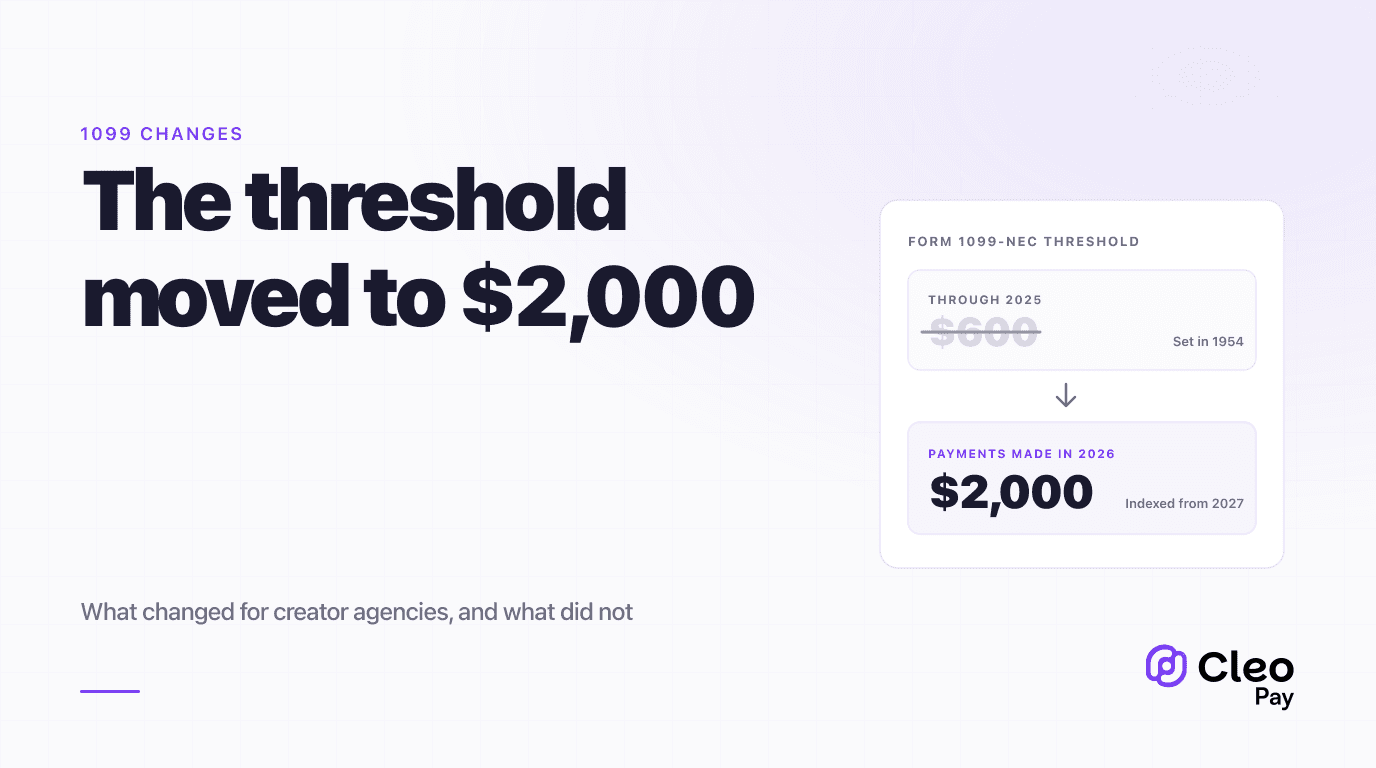
The headline is that you will file fewer forms. Under the One Big Beautiful Bill Act, the Form 1099-NEC and 1099-MISC reporting threshold rose from $600 to $2,000 for payments made in 2026, with inflation indexing from 2027 forward. For an agency with a long tail of creators who did one campaign each, that removes a real number of forms.
The trap is assuming fewer forms means less work. Three things get harder.
You still have to track every payee, including the ones you will not file for. The threshold is an annual aggregate, so you cannot know in March whether a creator will finish the year above or below $2,000. Track full-year totals for everyone and let the software decide at year end who crosses the line. An agency that stops collecting W-9s from small creators because "they will be under the threshold anyway" will discover in December that four of them ran three campaigns each.
Your state may not have followed. State reporting thresholds are set by states, and many did not change. A payee you correctly skip federally may still generate a state filing obligation. This is the most common way agencies get the new rule wrong.
Tax year is not filing year. The $2,000 threshold applies to payments made during 2026, reported on forms filed in early 2027. Forms filed in early 2026 covered tax year 2025 and used the old $600 threshold. Our breakdown of the threshold change walks through this timing, because it is easy to apply the new number a year early.
What 1099 filing software actually has to do
Strip away the marketing and there are six distinct jobs. Most tools do three or four well. The gaps are where January goes wrong.
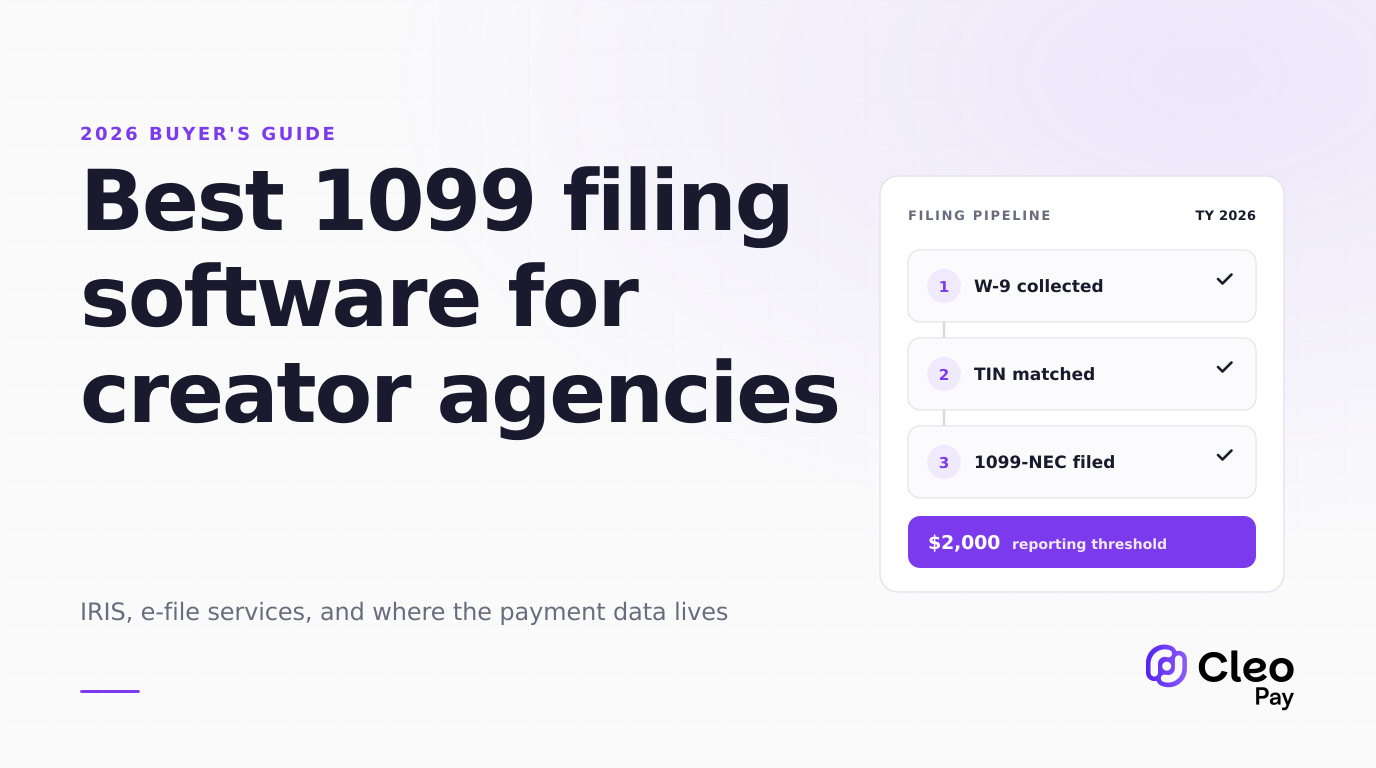
- Collect and store the W-9. Legal name, entity type, and TIN, captured before the first payment rather than chased afterward.
- Validate the name and TIN combination against IRS records. Not just capture it. Validate it.
- Aggregate payments per payee per calendar year. The most underestimated job, because it depends entirely on whether the tool can see all of your payments.
- Generate the forms and furnish them to recipients. Including consent if you deliver electronically rather than by mail.
- Transmit to the IRS, and to states where required. Separate obligations with separate rules.
- Handle corrections. Some forms will be wrong, and the correction workflow is where cheap tools stop being cheap.
The software you file with matters far less than whether the system that paid the creator is also the system that knows their validated TIN.
A filing tool is a transmitter. If you feed it a spreadsheet assembled by hand from three payment sources in January, the quality of the transmitter is close to irrelevant.
The evaluation criteria that matter for agencies
Where the payment data comes from
Score this first and weight it heaviest. The question is not "can this tool file a 1099" but "does it already know what we paid each creator." If the answer requires a CSV export, a manual merge, and a reconciliation pass, you have bought a form generator, not a filing system. Agencies paying through a mix of bank transfers, a payout platform, and the occasional P2P app have the hardest version, because no single system holds any payee's full-year total.
TIN validation, and what happens when it fails
The IRS offers free On-Line Taxpayer Identification Number Matching through e-Services, letting payers check a name and TIN combination against IRS records before filing. Interactive matching handles up to 25 combinations at a time, with a limit of 999 requests in a 24 hour period. Bulk matching handles up to 100,000 combinations, with results typically back within 24 hours. The IRS notes that payers who validate before filing can expect fewer CP2100 and penalty notices.
Ask any vendor two questions: do you run TIN matching, and what is the workflow when a match fails? The second separates tools. A failed match needs to trigger outreach to the creator, not a silent flag in a dashboard nobody opens until January.
Recipient delivery and corrections
Electronic delivery of recipient copies is faster and cheaper than mail, but it requires the recipient's affirmative consent, captured in a specific way. Tools differ in whether they handle that consent flow or quietly assume you obtained it.
On corrections, ask what one costs and how long it takes. Some tools include them, some charge per corrected form, some route them through a different channel entirely. Agencies with many small payees generate more corrections than most businesses, because creator legal names and entity types are frequently entered wrong the first time.
State filing
Confirm which states the tool files to directly, which it supports through a combined federal and state program, and which it leaves to you. Because state thresholds did not uniformly follow the federal move to $2,000, this went from a minor line item to a real criterion for tax year 2026.
International creators
If part of your roster is outside the US, you need W-8 collection rather than W-9, and potentially other reporting regimes. Most US-focused 1099 filing tools do not handle this well, which is usually why an agency ends up on a mass payout platform instead.
How pricing scales
Filing tools generally price per form on a volume-tiered basis, so the rate falls as volume rises. Payout platforms that include filing bundle it into the subscription. Neither model is better, but they behave very differently at 40 forms versus 400. Published pricing goes stale fast, so get a current quote at your actual volume.
The four categories of tools
The IRS IRIS portal. The Information Returns Intake System lets any business, of any size, e-file the full Form 1099 series directly with the IRS for free. Key forms in or upload from a downloadable template, download completed copies, submit extensions, and file corrections, with confirmation of receipt in as little as 48 hours. Access requires an IRIS Transmitter Control Code, a 5-digit code you apply for, and that application is the part agencies underestimate. What IRIS does not do is collect W-9s, validate TINs, aggregate your payments, or file to states.
Standalone e-file services. Dedicated filing platforms handle recipient delivery, federal transmission, corrections, and often state filing, with volume-tiered per-form pricing. They fit an agency whose payment records are already clean. What they do not solve is the upstream problem: they file what you give them, so a messy source of truth stays messy.
Accounting or payroll add-ons. Filing from inside the system that holds your ledger removes an export step. The limitation is coverage: these tools only know about payees and payments that flowed through the ledger. Agencies that pay some creators outside the accounting system, which is most agencies, end up reconciling anyway. Our QuickBooks bill pay comparison covers the shape of this tradeoff.
Payout platforms with filing built in. If the system that pays creators also collected and validated their W-9, the 1099 is a byproduct rather than a project. Cleo Pay's creator agency product sits here, capturing W-9s with TIN verification at onboarding and preparing 1099-NEC forms from payment data it already holds. Published pricing, as of October 2026, is $55 per seat per month on Starter with 1 seat and 20 payments included at $3 per additional payment, or $75 per seat per month on Growth with 3 seats (from $225) and 100 payments included at $2 per additional payment. For comparison, BILL, the per-seat AP platform agencies most often benchmark against, published tiers at $49, $65, and $89 per user per month plus a custom Enterprise tier. The tradeoff for this category is international breadth, which mass payout platforms still handle better.
The routes, and what they cost
- Speed
- Confirmation in as little as 48 hours
- Cost
- Free
- Best for
- Clean data, modest volume, no state obligations
- Speed
- Vendor-managed submission
- Cost
- Per form, volume tiered
- Best for
- Several hundred forms from a consolidated source
- Speed
- Filed from the ledger
- Cost
- Per form, often bundled
- Best for
- Agencies paying every creator through one accounting system
- Speed
- Prepared continuously through the year
- Cost
- Included in the subscription
- Best for
- Many creators, where the payout system is the source of truth
Two cost items agencies leave out: recipient copy delivery, which is cheap electronically and not cheap by mail, and staff time, which dwarfs both. An operations person spending two weeks in January assembling payee totals costs more than any of these tools.
Red flags when you evaluate
The demo starts with a CSV upload. That is a transmitter, not a filing system. Ask where the payee data comes from.
No answer on what happens when a TIN fails validation. This happens constantly with creator rosters, and a vague answer means you handle it manually.
State filing described as "supported" without specifics. Ask which states, filed directly or through a combined program, at what cost.
The new $2,000 threshold pitched as "less to track." It is less to file, not less to track. A vendor that blurs those two has not thought carefully about the change.
What to do in September, not January
The useful work happens now, while creators are still engaged with active campaigns and will actually respond to an email.
Form 1099-NEC is due to both the recipient and the IRS by January 31 under section 6071(c), the same date for paper and electronic filers. When January 31 falls on a weekend the deadline moves to the next business day, which is how the tax year 2025 deadline landed on February 2, 2026. Plan against the statutory date and the shift never catches you.
Electronic filing is not optional at volume: file at least 10 information returns in a calendar year, counted as an aggregate across nearly all return types rather than per form type, and you must file them electronically. Most agencies clear 10 easily.
The short version
The best 1099 filing software for a creator agency is usually not a filing tool at all. It is whichever system already holds a validated W-9 and the complete payment record for every creator you paid. That input decides whether January is a two-hour task or a two-week one.
If your payment data is already consolidated and clean, buy on the boring criteria: state coverage, corrections handling, recipient delivery, and per-form cost at your real volume. IRIS is free, capable, and worth a serious look at modest volume.
If your payment data is scattered across a bank, a payout tool, and a couple of apps, no filing software fixes that. Consolidating payouts is the higher-leverage change, and it makes the filing question answer itself. Our creator payout software guide covers that decision, and paying creators at scale covers the threshold change in practice.
Whatever you choose, do the W-9 and TIN matching work now. It is free, it takes a few hours, and it removes the largest source of January pain.
Want to see W-9 capture, creator payouts, and 1099 preparation as one system on your roster? Book a walkthrough and bring a year-to-date payout export.