
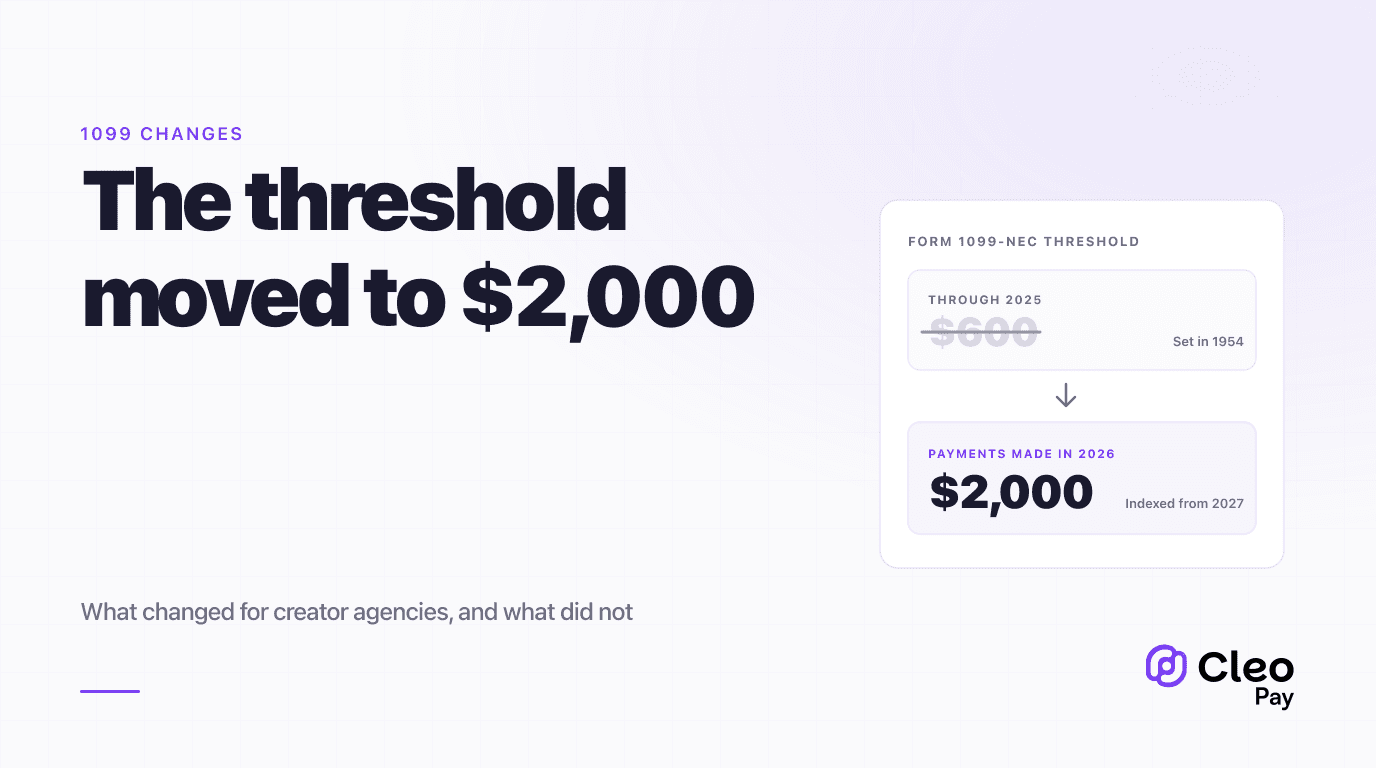
The 1099 reporting threshold just moved for the first time since 1954. Under the One Big Beautiful Bill Act, the Form 1099-NEC and Form 1099-MISC reporting threshold rises from $600 to $2,000 for payments made in 2026, with inflation indexing from 2027 forward.
For most businesses that is a modest paperwork reduction. For creator and talent agencies, which pay large numbers of people relatively small amounts, it is one of the more consequential changes in years. The House Ways and Means Committee estimated the change removes the need for more than a third of all 1099-MISC paperwork.
It also creates a trap. This guide covers what actually changed, the three things that did not change and will still ruin your January if you get them wrong, and how to structure payouts so the tax work happens throughout the year instead of all at once.
What actually changed
The threshold, and only the threshold. For payments made during calendar year 2026, you generally issue a Form 1099-NEC to a US non-corporate payee for services when total payments for the year reach $2,000, rather than $600. The same lift applies to Form 1099-MISC. From 2027 onward the figure is adjusted for inflation.
For an agency paying a long tail of creators a few hundred dollars per campaign, this removes a real amount of work. A roster where half the creators clear $800 a year and never come back used to generate a pile of forms in January. Many of those forms are no longer required.
The three things that did not change
1. You still need the W-9 before you pay
The threshold governs when you file a form. It does not govern when you collect tax identity. You cannot know in March whether a creator will cross $2,000 by December, and by the time you know, they may be unreachable.
Collect the W-9 at onboarding, before the first payment, from every creator. There is no version of this that works better later. A creator who is waiting on money is highly responsive. A creator who finished one campaign nine months ago and has since changed agencies is not.
2. Backup withholding still applies
If a payee has not furnished a valid taxpayer identification number, you are generally required to withhold 24% of reportable payments and remit it to the IRS. The same obligation attaches when the IRS sends a CP2100 notice indicating a TIN mismatch and the payee does not correct it.
The B-notice process has real deadlines. After receiving a CP2100, you have 15 business days to send a First B-Notice with a blank Form W-9. If a corrected W-9 does not come back within 30 business days, backup withholding begins on future reportable payments to that payee.
None of this is triggered by the payment amount. It is triggered by a missing or bad TIN. A creator who earns $900 with a wrong TIN can still put you in the B-notice process.
3. The recipient still owes tax
A creator paid $1,500 in 2026 will not receive a 1099-NEC from you, and still has to report that income. Worth saying plainly to your roster, because the absence of a form is going to be widely misread as the absence of an obligation. Agencies that communicate this early avoid an uncomfortable round of questions the following spring.
Verify the TIN, do not just collect it
Collecting a W-9 and validating it are different things. A form with a transposed digit looks complete in your files and fails at the IRS.
TIN matching checks the name and taxpayer identification number combination against IRS records before you file. Catching a mismatch at onboarding costs a two-minute correction. Catching it after filing means corrected returns, a B-notice cycle, and potentially backup withholding on a creator who did nothing wrong and will be unhappy about the deduction.
The common failure modes are predictable and worth screening for:
- A creator submits their stage name rather than their legal name
- A single-member LLC enters the LLC name with the owner's SSN, or the reverse
- A creator uses a business name that was never registered with the IRS under that EIN
- A married creator's name changed and the SSA record has not caught up
Building the payout process
Onboard once, pay many times
The strongest pattern is a single creator intake that captures everything at once: legal name, tax identity, bank details entered by the creator rather than your team, and agreement to your payment terms. Every subsequent payout draws on that record.
The alternative, where an account manager collects bank details in a DM for each campaign, is the source of most mispayments and is a genuine fraud vector. A payment redirect message that looks like it came from a creator is easy to send and hard to catch when bank details arrive through chat as a matter of routine.
Batch, approve, then send
Paying creators one at a time invites typos and makes approval meaningless. Generate the batch from campaign data, have someone with authority review the total and the recipient list, and execute as one action.
Two things to insist on: per-recipient status inside the batch, so a single bad account number does not silently drop someone, and an audit trail showing who approved what. When a creator says they were not paid, you want a record rather than a search through chat history.
Default to standard rails, expedite by exception
Standard ACH generally settles in one to two business days and costs the least. Same-day and instant options exist and cost more per payment. Creators consistently rate payment speed highly, so the temptation is to make everything instant.
The better structure is a standard default with the ability to expedite specific payouts: a creator in a genuine bind, a make-good on a late payment, a top performer you want to keep happy. Paying a premium on all 200 payouts to solve a problem that affects five is expensive. Our comparison of same-day and standard ACH has the cost math.
Tag payouts as you make them
The reason January is a fire drill at most agencies is that nobody labeled anything during the year. If each payout is tagged with the payee's tax identity, the campaign, and whether it was compensation or reimbursement, the 1099 process becomes a report rather than a reconstruction.
This is also what lets you answer which campaigns actually made money, which most agencies cannot do without a manual exercise.
What about international creators
The $2,000 threshold change applies to Forms 1099-NEC and 1099-MISC, which cover US persons. Non-US creators are a separate track and the change does not help you there.
Non-US creators generally provide Form W-8BEN as individuals or W-8BEN-E as entities, rather than a W-9. Withholding rules differ, treaty benefits may apply, and reporting may run through Form 1042-S rather than a 1099. If a meaningful share of your roster is outside the US, this is worth a conversation with your accountant rather than a policy you infer from a blog post.
Practically: route creators to the correct form at onboarding based on tax residency, and do not let a W-9 be the default that everyone clicks through.
The short version
The threshold moved from $600 to $2,000 for payments made in 2026, which meaningfully reduces the number of forms a creator agency files. It changes nothing about collecting a W-9 before the first payment, validating the TIN, or backup withholding when the TIN is missing or wrong.
The one new risk worth naming: because the threshold is annual and cumulative, an agency that tracks payouts by campaign rather than by tax identity will now miss more creators than it used to. If your records cannot produce year-to-date totals per payee on demand, fix that before you worry about anything else on this page.
If you are choosing tooling to support this, our buyer's guide to creator payout software covers the categories and pricing, and our W-9 collection guide covers the intake process in detail.
Want to see W-9 capture, TIN verification, and batch payouts running as one flow? Book a walkthrough.