
Creator agencies have a payments problem that looks nothing like a normal small business. A typical agency collects from a handful of brand clients on net-30 terms that quietly become net-60, then turns around and pays out to two hundred individual creators, most of whom are sole proprietors with no invoicing process, several of whom are overseas, and nearly all of whom will need a tax form in January.
Generic accounts payable software was not designed for that shape. This guide covers the criteria that actually matter when you are paying many small recipients rather than few large vendors, how the main categories of tools compare, and the failure patterns worth avoiding.
Why generic AP tools struggle with creator agencies
Most accounts payable platforms are built around an assumption that holds for a law firm and breaks for a talent agency: a modest number of established vendors, each sending a formal invoice, each paid on a predictable cycle.
The specific ways that assumption fails:
- Creators do not invoice. They agree to a deal in a DM and expect payment when the content posts. The agency is generating the payable, not receiving it, which inverts the workflow most AP tools are designed around.
- Per-user pricing punishes the wrong thing. Seat-based pricing is fine when five people approve bills. It says nothing about whether the tool can handle two hundred payees, and it does not scale with the dimension that actually grows.
- W-9 collection happens too late. Generic tools treat tax forms as a year-end reporting task. Agencies need the W-9 captured before the first payment goes out, because chasing a creator who ghosted after one campaign is close to impossible in January.
- Batch payouts are an afterthought. Paying two hundred creators one at a time is not a workflow, it is a data entry job with a typo risk on every row.
- International is either missing or expensive. A meaningful share of creator rosters are outside the US, and the difference between a good and bad cross-border rail is real money on a $400 payout.
- White-label invoicing does not exist. Agencies bill brands under their own name. A tool that sends invoices branded as the software vendor is a non-starter for client-facing work.
The evaluation criteria that actually matter
1. Tax identity capture at onboarding, not at year end
This is the single highest-leverage criterion. The tool should collect the W-9 as part of creator onboarding, before the first payment, and it should validate the TIN against IRS records rather than simply storing whatever was typed in. A mismatch discovered in January triggers a B-notice process and potentially 24% backup withholding. The same mismatch caught at onboarding is a two-minute fix.
Ask specifically: is TIN matching performed, and what happens when it fails?
2. 1099-NEC preparation from tagged payouts
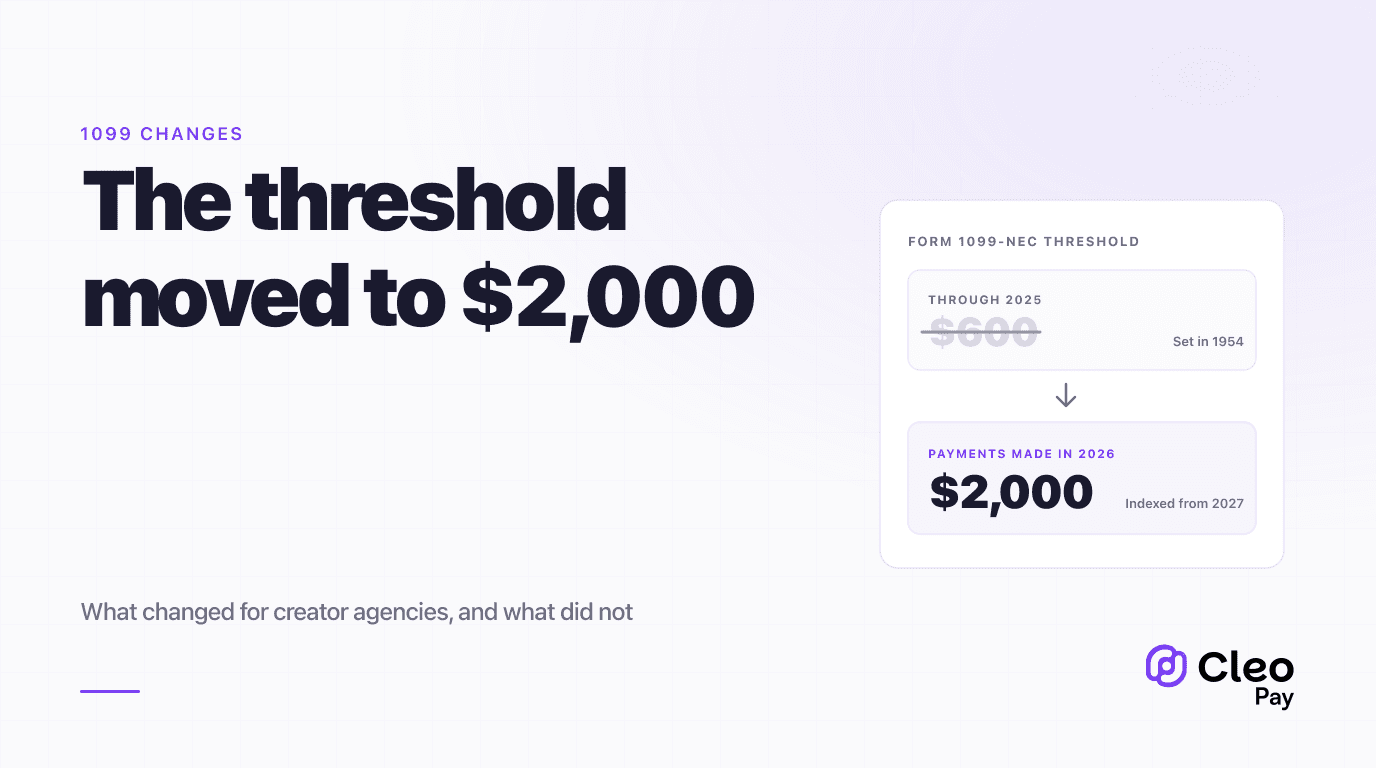
If the platform knows which payouts were compensation to a US person, it can prepare the forms. If it does not track that distinction, you will be reconstructing it from bank exports every January. Ask whether 1099-NEC preparation is included, whether e-filing is included or an add-on, and whether the platform handles the new $2,000 threshold correctly for payments made in 2026.
3. Creator self-service onboarding
The workflow that scales is one where you send a link, the creator enters their own bank details and tax information on their phone, and your team never handles either. The alternative, where an account manager collects routing numbers over Slack and types them into a payout file, is both a security problem and the source of nearly every mispayment.
4. Batch payouts with real approval controls
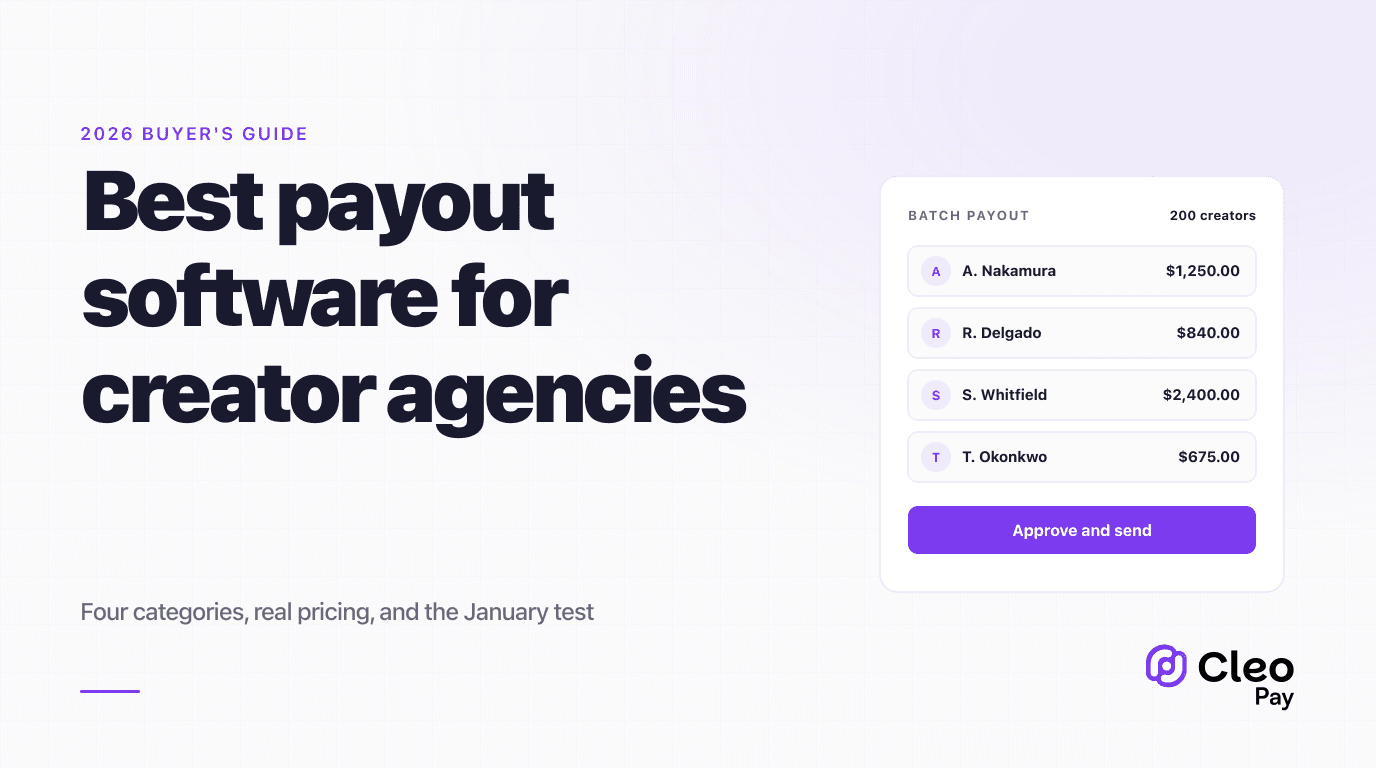
You want to upload or generate a batch, have someone with authority approve it, and have the whole thing execute as one action with a per-recipient status. Two questions separate serious tools from spreadsheets with a payment button: can a batch be partially approved, and what happens to the rest of the batch when one recipient's bank details fail?
5. Payout speed and rail choice
Creators care about speed more than almost anything else, and it is a genuine retention lever for an agency's roster. Standard ACH lands in one to two business days. Same-day and instant options cost more per payment. The right answer is usually a default of standard with the ability to expedite specific payouts, rather than paying a premium on every transaction. Our breakdown of ACH timing covers the tradeoffs in detail.
6. White-labeled client invoicing
The receivable side matters as much as the payout side, because agency cash flow is the gap between them. If the tool can send brand invoices under your agency's branding and track what is outstanding, you have one system instead of two.
7. Accounting sync that preserves the detail
A sync that pushes a single lump-sum payout batch to QuickBooks is nearly useless. You need per-creator, per-campaign detail so you can see margin by deal. Ask what granularity the integration writes at.
8. Pricing that scales on the right axis
Compare cost per payout at your actual volume, not headline subscription price. An agency paying 200 creators a month has a very different cost curve than one paying 20, and the tools optimize for different points on it.
The four categories of tools
Manual bank transfers and P2P apps. Free or nearly free, and where most agencies start. The breaking point is usually somewhere between thirty and fifty creators, when reconciliation stops being possible and the January tax scramble becomes a multi-week project. Worth naming explicitly: P2P apps are also a poor fit for business payments because they produce weak records, and payment app reporting rules do not substitute for your own 1099 obligations.
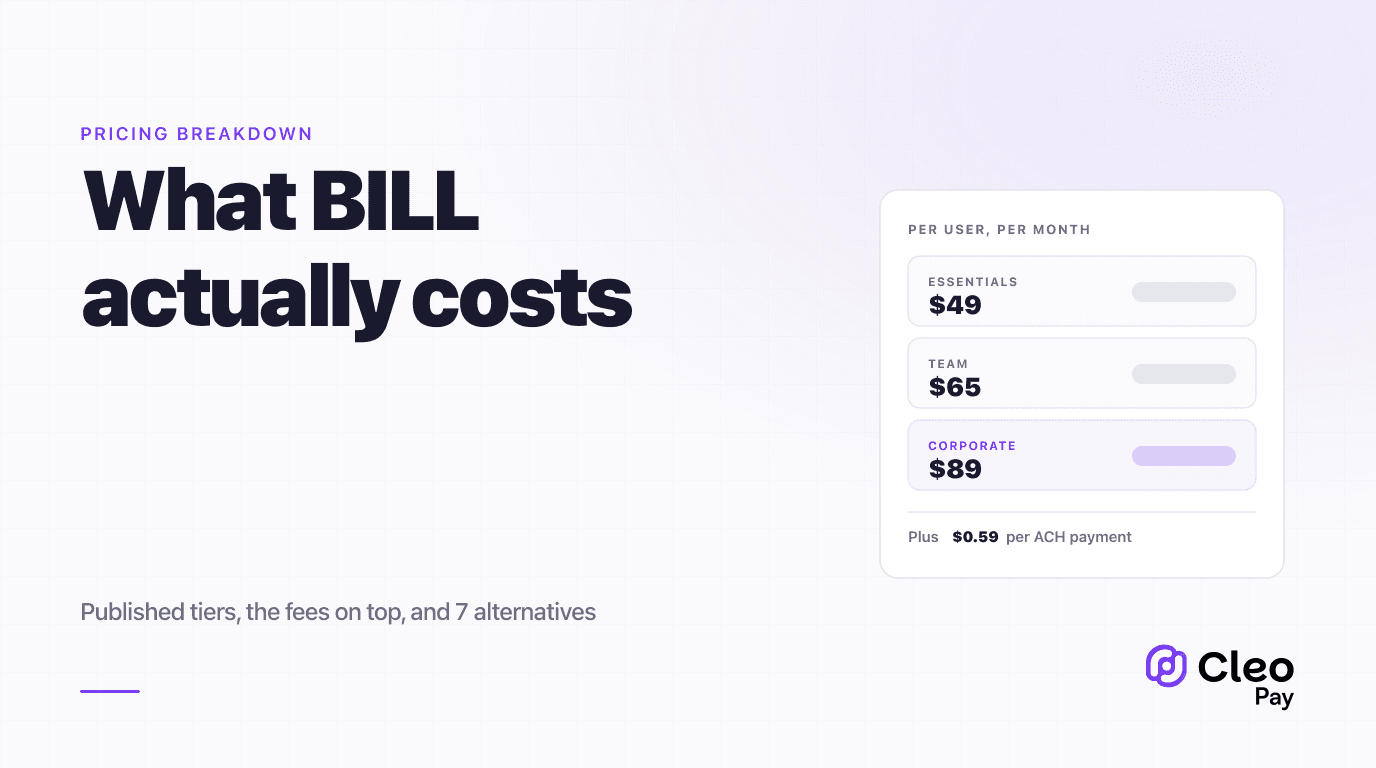
Generic AP platforms. BILL, Melio, and similar tools are excellent at what they were built for, which is paying vendors who send invoices. They will move money reliably and sync cleanly to your accounting system. Where they struggle is the creator-specific layer: onboarding at scale, treating payouts as agency-generated rather than invoice-driven, and per-seat pricing that does not reflect payee volume. Our BILL pricing breakdown has the full cost math if you are comparing against this category.
Mass payout platforms. Tipalti and Trolley are purpose-built for paying many recipients, with strong tax compliance tooling and genuinely broad international coverage. Trolley reaches 210 or more countries and territories and handles both W-9 and W-8 collection plus year-end forms. This is the strongest category if a large share of your roster is outside the US. The tradeoffs are cost and fit: Tipalti's platform fee starts around $99 per month with custom pricing above that, pricing on both is typically quote-based with per-transaction fees layered on, and both are built for platforms and marketplaces rather than for an agency that also needs to invoice brand clients.
Agency back-office platforms. Tools that combine the receivable side and the payout side because agency cash flow lives in the gap between them. Cleo Pay's creator agency product sits here, covering white-labeled invoicing, batch creator payouts, W-9 collection with TIN verification at onboarding, automatic 1099-NEC preparation, approvals with audit trails, and QuickBooks sync. Published pricing is $99 per month on Basic with 15 payments included and $3 per additional payment, or $299 per month on Pro with 10 seats, 100 payments included, and $2 per additional payment. The tradeoff versus the mass payout platforms is international breadth.
Red flags in a demo
The rep cannot explain what happens when a TIN fails validation. This is the most consequential edge case in creator payouts and it happens constantly. A vague answer means you will be handling it manually.
W-9 collection is described as a year-end feature. It should be an onboarding feature. If the product treats it as reporting rather than intake, you will still be chasing forms in January.
No per-recipient status inside a batch. Ask to see a batch where one recipient's account details are wrong. If the entire batch fails or the failure is silent, that is a weekly operational problem waiting to happen.
Pricing quoted only per seat. Ask for the total at your actual payout volume, including transaction fees. Seat pricing tells you almost nothing about what a creator agency will pay.
Payouts require your team to handle bank details. If there is no creator-facing self-service flow, your account managers are collecting routing numbers in chat. That is both a fraud vector and the main source of mispayments.
What agencies underestimate
Onboarding the existing roster. Whatever tool you pick, you have to get every current creator through the new intake flow. Budget real time, and expect that a meaningful percentage of your roster will not respond on the first ask. Doing this alongside a campaign cycle, when creators are already engaged, works far better than a standalone request.
The receivable side. Payout software solves half of the cash problem. If brands are paying you at day 55 and creators expect payment at day 10, faster payouts make the float worse, not better. Look at both sides together.
Deal-level margin. The reason to care about accounting granularity is that agencies often cannot answer which campaigns were actually profitable after payouts, fees, and the account management time. A tool that tracks payouts against campaigns gives you that answer without a manual exercise.
The short version
The criteria that separate tools for creator agencies from general AP software are all about the payee side: capturing a validated W-9 before the first payment, running batches with per-recipient status, letting creators onboard themselves, and preparing 1099s from data the system already has.
Roster geography usually decides the category. Heavily international rosters point to a mass payout platform. Mostly US rosters at an agency that also invoices brand clients point to a combined back-office tool, because the cash flow problem lives in the gap between the two sides.
Whatever you choose, fix W-9 collection first. It is the cheapest change available and it removes the single biggest source of January pain. Our W-9 collection guide covers the process, and paying creators at scale covers the 2026 threshold change in detail.
Want to see the payout and invoicing sides together? Book a walkthrough.