
Most software written about travel agencies assumes the agency is the one collecting money. Booking engines, CRMs, client portals, and card-on-file vaults all point the same direction: from the traveler, to you.
Host agencies have the opposite problem. Money arrives from suppliers in irregular, unpredictable amounts, months after the booking was made, and then it has to be split and pushed back out to a roster of independent contractors who are watching for it. A host with 300 advisors is running a payouts operation, not an accounts payable department, and the tools sold as "bill pay" were not designed for it.
This guide covers what makes host agency commission payouts structurally different, the four categories of tools agencies actually use, the compliance work that has changed for 2026, and the criteria worth weighting in a demo.
Why host agency payouts are structurally different
The defining feature of this business is that you cannot pay the advisor until the supplier pays you, and the supplier pays on a schedule nobody controls.
Most suppliers pay commission on travel completion rather than on booking. A cruise booked in January for a June sailing may not generate a commission check until July or August. That single fact reshapes everything downstream:
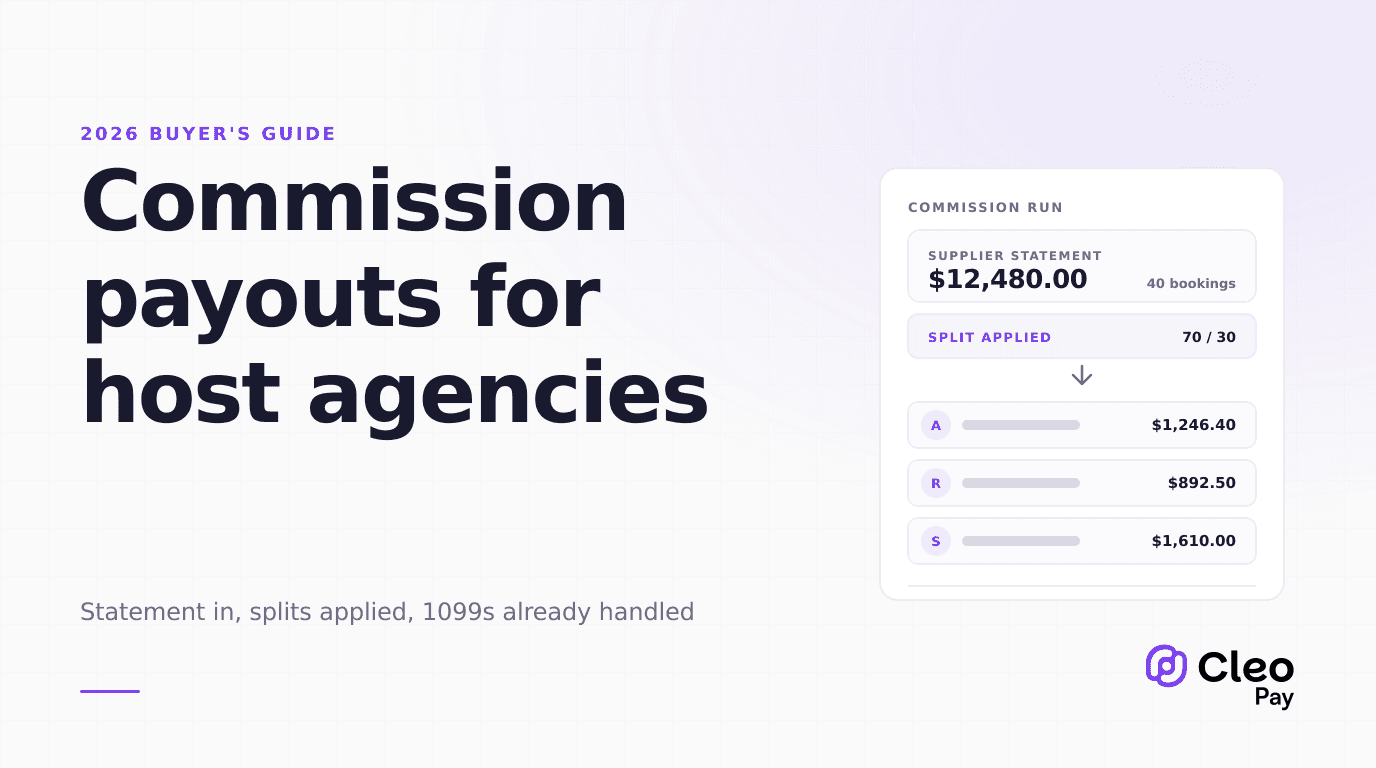
The payable is created by a receipt, not by an invoice. In normal AP, a vendor sends you a bill and you decide when to pay it. Here, a commission statement arrives from a supplier, you match it against bookings, apply a split, and only then does an obligation to the advisor exist. Tools built around inbound invoices have no natural place to put this.
One inbound payment fans out to many advisors. A monthly statement from a consortium or a large supplier can cover dozens of bookings belonging to dozens of different advisors. The reconciliation is one-to-many, and it is the actual work.
Splits are layered, not flat. A sub-agent arrangement means the host takes its split first, then the managing advisor applies a second split to the sub-agent. A 70/30 agreement at each level compounds, and the arithmetic has to be visible to everyone or it becomes a trust problem.
The amounts are small and the volume is high. A roster of 200 advisors paid twice a month is 4,800 payments a year, many for double-digit amounts. Per-payment pricing that looks trivial on a restaurant's 40 vendor bills becomes the dominant cost here.
Your payees are independent contractors, not vendors. They need W-9s and 1099-NECs, and they turn over. This is a payee lifecycle problem, and it looks much more like paying creators than like paying Sysco.
The evaluation criteria that actually matter
Vendor comparison charts in this category tend to rank on generic AP features. These are the criteria that separate a tool that fits a host agency from one that does not.
Commission statement ingestion. Suppliers send statements as PDFs, CSVs, and portal exports in no consistent format. Ask how the product gets that data in. If the answer is "you can import a CSV," ask who normalizes the twelve different CSV shapes you receive.
Booking-level attribution. Every dollar paid to an advisor should trace back to a named booking with a supplier, a traveler, and a travel date. Without it you cannot answer questions and you cannot audit.
Configurable split rules, applied automatically. Splits vary by advisor, tier, supplier, and sometimes by individual booking. If splits are calculated in a spreadsheet and typed into the payment tool, the spreadsheet is your real system and you are buying a payment button.
Advisor self-service bank details. Your team should never collect routing numbers over email or chat. That is both a fraud vector and the largest source of failed payments. Advisors should enter and update their own details behind authentication.
W-9 capture before the first payment. Chasing a W-9 in January from an advisor who left in September is close to impossible. The form should be a precondition of activation, not a year-end task.
Batch payments with per-recipient status. When you release 200 payments and three fail, you need to see exactly which three and why, without the batch rolling back or failing silently.
A statement the advisor can read. Advisors should get a breakdown showing each booking, gross commission, split applied, and net. This is the highest-leverage feature for reducing inbound questions.
The four categories of tools
Host agencies generally end up in one of four places. None is universally correct, and the right answer depends mostly on roster size and how much commission tracking you need the same system to do.
Manual bank and P2P. A bank portal with an ACH batch file, or individual transfers. Free at the margin and workable at small scale, it breaks on the payee lifecycle: no W-9 capture, no 1099 preparation, no advisor-visible statement, no per-recipient failure handling. Agencies stay here longer than they should because the cost is invisible until someone counts the hours.
Generic AP platforms. BILL and QuickBooks Bill Pay are mature, well-integrated products that handle approvals and vendor payments well. The mismatch here is structural rather than a quality problem: they are priced and modeled around vendor bills, not contractor payouts. BILL's published Accounts Payable tiers run $49, $65, and $89 per user per month plus an Enterprise plan, with ACH at $0.59 per payment, same-day ACH at $11.99, checks at $1.99, international USD wires at $19.99, and card payments at 2.9%. For a host paying thousands of small commissions, per-payment ACH cost is the number to model, and split arithmetic still lives outside the system.
Travel commission platforms. Purpose-built tools that track what suppliers owe you, match statements to bookings, and calculate splits. This is the hardest part of the problem and the category that solves it best. The gap is the last mile: many track commission thoroughly, then hand disbursement, W-9 collection, and 1099 preparation to something else.
Payouts-first back office. Tools built around paying a roster of contractors: self-service onboarding, batch payments with per-recipient status, 1099 preparation from the payment record. Strong on the payee lifecycle and priced for volume, but most do not natively read supplier commission statements, so tracking often stays upstream in a commission platform or spreadsheet.
What changed for 2026: the reporting threshold
The compliance side of contractor payouts moved this year, and it moved in a direction that reduces filing volume but increases the cost of sloppy onboarding.
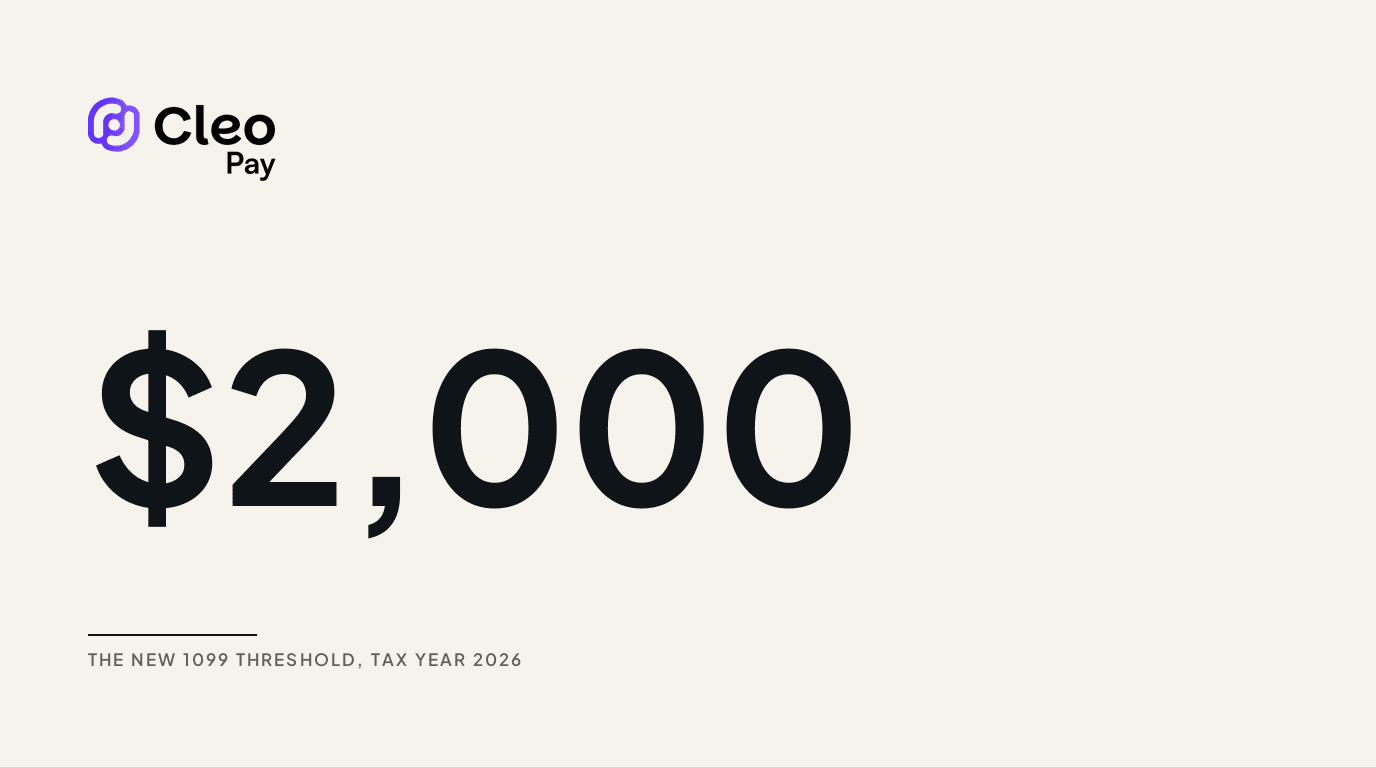
For tax years beginning after 2025, the minimum threshold amount for reporting certain payments required to be reported on certain information returns and/or perform backup withholding on those payments increased to $2,000 and may be adjusted for inflation beginning in calendar year 2027.
For payments made in 2026, the Form 1099-NEC reporting threshold for nonemployee compensation rose from $600 to $2,000 under the One Big Beautiful Bill Act, with inflation indexing beginning in 2027. For a host agency, this matters more than it does for most businesses, because commission payouts cluster heavily at the low end. A roster with a long tail of part-time advisors earning a few hundred dollars a year will see a meaningful number of them fall below the new threshold.
Three cautions before you act on that.
The threshold does not change who owes tax. Advisors paid below $2,000 still owe tax on that income. The change is about your filing obligation, not their liability, and it is worth saying so plainly to a roster that may misread it.
States set their own thresholds. Several states require filing at amounts below the federal figure. If you file in multiple states, the federal change does not simplify your state obligations, and you need to know which states you are in.
Backup withholding still applies at 24%. If an advisor fails to furnish a TIN, furnishes an incorrect one, or the IRS notifies you of a mismatch, you are generally required to withhold 24% of reportable payments. The backup withholding threshold aligned with the new $2,000 level for 2026, but the rate is unchanged.
The practical consequence is that W-9 collection gets more important, not less. You do not know at onboarding which advisors will cross $2,000, so the only workable policy is collecting a valid W-9 from every advisor before the first payment. Our W-9 collection guide covers the process, and the 2026 threshold change goes deeper on what to rescale in your systems.
Red flags in a demo
The rep cannot explain what happens when a TIN fails validation. This is a routine event on a large roster and it has a compliance consequence. A vague answer means your team will handle it by hand every time.
Splits are described as "configurable" without a demo. Ask them to build a two-level sub-agent split live. Configurability that requires a support ticket for each change is not configurability at your operating pace.
No advisor-facing statement. If the advisor receives a bank deposit with no breakdown, you have moved the reconciliation burden onto your account managers, who will rebuild it in email.
Pricing quoted per seat only. Host agencies have few internal users and enormous payment counts, so a per-seat quote tells you almost nothing. Ask for the all-in figure at your annual payment volume including transaction fees.
Commission tracking demoed only with clean sample data. Ask to see a real-shaped supplier statement, ideally a messy PDF. The gap between the demo file and your actual inbox is where implementations stall.
What agencies underestimate
The migration of advisor bank details. Every advisor has to re-enter or re-verify their payment information. This is a communications project, not a data import, and it is the most common reason a rollout slips. Plan a real window and expect a meaningful share of the roster to need a reminder. You will also run both processes for at least one cycle, so budget for that rather than discovering it.
Historical commission data. Deciding how much history to bring over is harder than it looks. Most agencies settle on starting clean at a period boundary and keeping the old system readable for reference, which is usually the right call.
Who owns the payout calendar. Twice-monthly payouts imply a cutoff, a review step, and an approval. If nobody owns those dates the schedule slips, and advisors notice immediately. Software will not make that operating decision for you.
Modeling the cost honestly
The comparison most agencies run is subscription price against subscription price. For this business that is close to meaningless, because payment volume rather than seat count drives the bill.
Work the math on your own numbers. Take your advisor count, multiply by your payout frequency, and that is your annual payment count. A 200-advisor roster paid twice monthly is roughly 4,800 payments a year. Then apply each vendor's per-payment fee to that number before you look at the subscription at all. A $0.59 ACH fee on 4,800 payments is about $2,832 a year in transaction cost alone, which for many agencies exceeds the subscription they were comparing.
- Speed
- 1–2 business days
- Cost
- Lowest per-payment cost
- Best for
- The default for scheduled commission runs
- Speed
- Same day
- Cost
- Substantially higher per payment
- Best for
- Genuine exceptions, not routine runs
- Speed
- Mail transit
- Cost
- Per-check fee plus reconciliation time
- Best for
- Advisors who will not provide bank details
- Speed
- Wire or local rail
- Cost
- Highest, and FX matters
- Best for
- Advisors outside the US
For scheduled payouts, standard ACH is almost always the correct default. Commission runs are known in advance, which is precisely the situation where paying a premium for speed buys nothing. Our same-day versus standard ACH breakdown covers when the premium is genuinely justified.
For reference on the other side of the ledger, Cleo Pay publishes flat pricing: a Free tier at $0, Basic at $99 per month covering one seat and 15 payments with additional payments at $3 each, and Pro at $299 per month covering 10 seats and 100 payments with additional payments at $2 each. As with any vendor in this category, model it against your own payment count rather than the headline number.
The short version
Host agency payouts are not accounts payable. The obligation is created by an inbound supplier statement rather than a vendor bill, one receipt fans out to many advisors, splits can be layered, and the payees are independent contractors with a W-9 and 1099 lifecycle attached.
Choose based on where your hours currently go. If reconciliation is the bottleneck, buy for commission tracking and attach a payment rail. If chasing W-9s, hand-keying transfers, and answering "what was this deposit for" is the bottleneck, buy for the payee side. Roster geography overrides both: a heavily international roster points to a mass payout platform regardless.
Whatever you choose, collect a valid W-9 from every advisor before their first payment, and give every advisor a statement they can read. Those two things remove more operational pain than any feature on a comparison chart.
If you also hold client card data on the booking side, our travel agency card storage guide covers that half of the problem, and the creator agency payout guide covers a roster payout model with very similar mechanics.
Ready to see batch payouts, advisor onboarding, and 1099 preparation in one place? Get started with Cleo Pay.