
Most teams do not go looking for a Canary alternative because the product stopped working. They go looking because something around it changed. A management company acquired the property and standardized on a different stack. The renewal quote came in higher than the budget line. The agency side of the business grew and the tool that was bought for front-desk authorizations is now being asked to hold client cards for repeat travelers, which is a different job.
This guide is for operators in that position: hotels, travel agencies, and hospitality groups who already run digital card authorizations and are evaluating what else exists. We cover what Canary genuinely does well, the four categories of tools that compete with it, the criteria worth scoring, and the migration questions that decide whether a switch is clean or painful.
Start by being honest about what Canary does well
An alternatives guide that opens by listing a competitor's flaws is not useful, because you will discover the flaws are mostly tradeoffs you are about to inherit somewhere else.
Canary's digital authorization product replaced a genuinely bad process for a lot of properties: the paper and PDF credit card authorization form, printed, signed, photographed, and emailed back with the full card number and security code sitting in the image. Canary describes the product as PCI Level 1 compliant, and it was voted the top provider in the cyber security and fraud prevention category of the 2026 HotelTechAwards. Independent properties in particular tend to rate it well.
It also bundles. Contactless check-in, checkout, upsells, guest messaging, and digital tipping sit alongside authorizations, and the pricing page states that users, data, and support are unlimited on every subscription. For a property that wants one vendor across the guest journey, that bundle is the product, and no point solution will match it.
So the honest framing is this. If your problem is guest-journey software for a hotel, Canary is a strong incumbent and the burden of proof is on the alternative. If your problem has drifted away from the guest journey, the bundle stops being an advantage and starts being something you pay for and do not use.
The question is not whether Canary is good. It is whether the job you need done in 2026 is still the job you bought it for.
The five reasons teams actually evaluate a switch
In practice the trigger is almost always one of these, and naming yours matters because it determines which category below you should be shopping in.
The workflow moved from front desk to back office. Authorizing a guest's card at check-in and holding a client's card on file for eight months of repeat bookings are different problems. The first is a transaction. The second is storage, and storage is where compliance scope lives.
The bundle stopped fitting. You are paying for guest messaging and upsells because they came with the authorizations. If you use one module out of six, the effective cost of that module is the whole subscription.
Procurement wants published pricing. Quote-only pricing is normal in hotel tech, but it makes budgeting and renewal comparison harder, and some finance teams now treat it as a disqualifier on its own.
You are an agency, not a property. Travel agencies sit on the other side of the authorization. You are the party sending the card, not the party collecting it, and tools built for the front desk fit that direction awkwardly.
Consolidation. The card tool is one of nine subscriptions and someone has been asked to get it to five.
The evaluation criteria that actually matter
Feature grids from vendors tend to compare things that are table stakes. These are the criteria that separate tools once you get past the demo.
Where the card data actually lives. This is the single most consequential question and it is frequently answered vaguely. If the vendor holds the card and hands your system a token, your compliance scope shrinks dramatically because there is no card number in your environment to protect. If the card lands in your database, encrypted or not, you own a cardholder data environment. Ask the question in exactly those terms and do not accept an answer that describes encryption instead of custody.
Whether the tool tempts you into storing the security code. The security code cannot be retained after authorization completes, and PCI DSS treats this as absolute, with no exception for refunds and no encryption workaround. The practical failure mode is a tool that makes re-authorization hard, because staff then start writing the code down somewhere so they do not have to ask the guest again. A tool that supports clean re-authorization from a token is the one that keeps you honest.
Re-authorization without re-collection. Related and worth its own line. If a supplier or property comes back six weeks after booking needing a fresh authorization, can you do it from what you already hold, or does the client have to re-enter their card? This is the workflow that pushes teams into bad storage habits more than any other.
Per-user access and instant revocation. Shared logins make offboarding unsolvable. When someone leaves, you need to revoke one account, not rotate a password that eleven people know. Ask what the audit log records and whether it distinguishes viewing a card from using one.
Full number visibility by default. A well-designed vault shows the last four digits by default and requires a deliberate, logged action to reveal or use the full number. If every logged-in user can read every card at a glance, the audit log is recording activity you did not intend to permit.
Direction of the workflow. Collecting from a guest and sending to a supplier are opposite flows. Most hotel tools do the first well. Agencies need the second.
Exit terms. Covered below, because it is the criterion teams skip and regret.
The four categories of alternatives
Hotel guest-journey suites. Canary is the reference point here, with Duve, Akia, and similar platforms competing on the same bundle logic. You are buying breadth across the guest experience and authorizations are one module. Right answer when you are a property and the bundle is genuinely used. Wrong answer when you use one module, or when your workflow is agency-side.
Authorization and payment specialists. Sertifi by Flywire is commonly named as the leading Canary alternative for mid-sized hotels, and pairs authorizations with e-signature and payment collection. Sertifi describes instant card verification using a machine learning fraud model that produces a risk score before the form comes back, which is the sort of capability that matters when you are absorbing chargeback risk. ChargeAutomation competes in the same space with auto-collection of deposits, card validation, and e-authorization. This category is the natural landing spot when authorizations and payments are the actual job and the guest-messaging bundle is not.
Operations-tied tools. Hotel Central is positioned for properties that want authorizations wired into operations rather than standing alone: front-desk handoffs, guest context, fraud analysis, chargeback rebuttal documents, and follow-up notes attached to the record. The pitch is that an authorization is not a document, it is a step in a workflow that someone has to finish. Worth a look when disputes are the pain rather than collection.
Agency-side vaults. Purpose-built card-on-file storage for organizations that hold a client's card and pay suppliers with it. This is the category most comparison content ignores, because the hotel tech ecosystem is written for properties. It is where travel agencies, executive assistants, and destination management companies actually belong. Cleo Pay Vault sits here, and so does the internal spreadsheet you are trying to replace. We maintain a side-by-side comparison of Cleo Pay Vault and Canary for agencies evaluating that specific swap.
The compliance question that quietly decides your shortlist
Every tool in every category above will tell you it is secure. That word does not discriminate between options, so replace it with a question that does: after we implement this, does a card number exist anywhere in our environment?
If the answer is no, because the vendor holds the card and your systems only ever see a token, then most of the standard's heaviest requirements apply to the vendor rather than to you. If the answer is yes, you have a cardholder data environment, and every device and account that can reach it comes into scope with it. Storing card data digitally is what moves organizations onto SAQ D, the longest and most demanding of the self-assessment questionnaires.
Two things follow that are worth stating plainly.
The first is that the security code is not storable. Not encrypted, not briefly, not for refunds. It may be held only for the seconds it takes to complete authorization, then it must be rendered unrecoverable. Any process that depends on retrieving a security code later is a process that needs redesigning, not a tool that needs replacing.
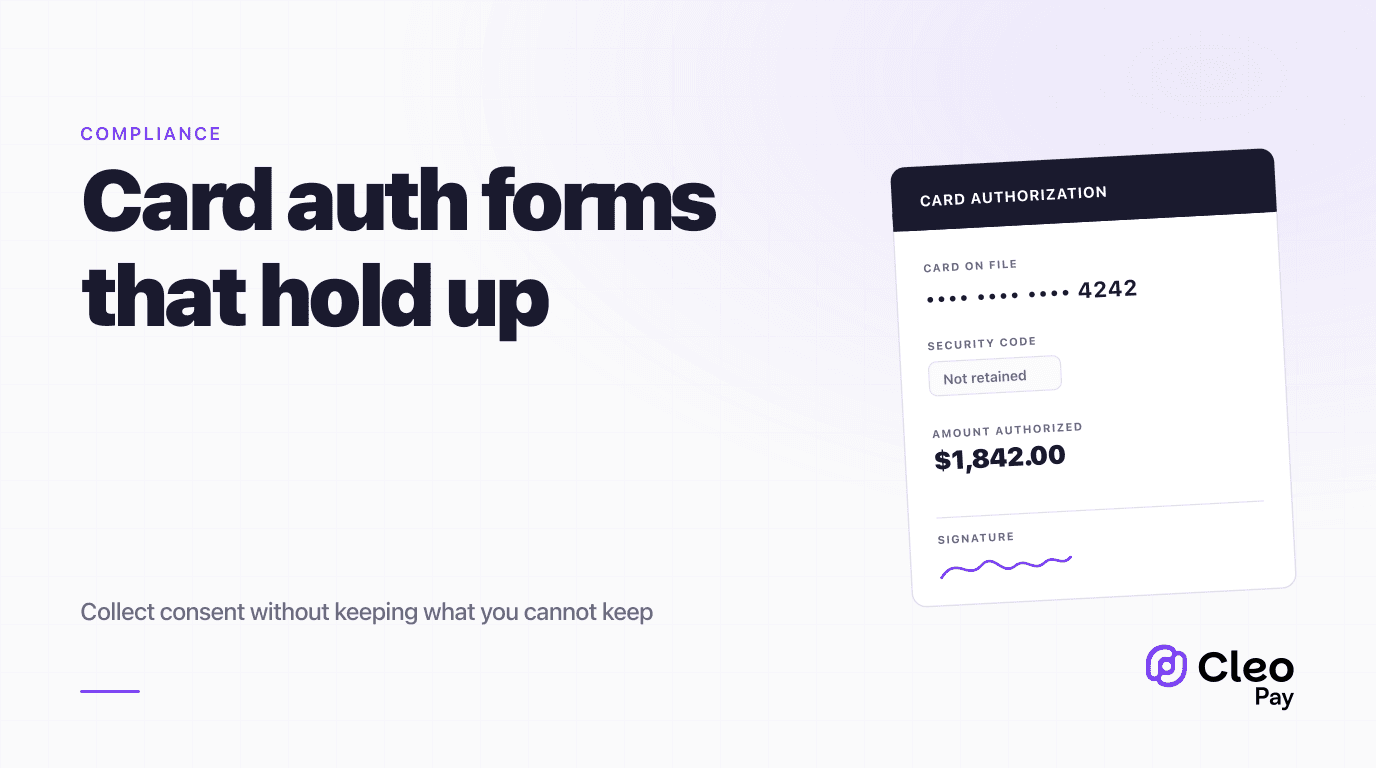
The second is that a signed authorization form creates a direct tension: it is a record you need for dispute defense, and it contains data you are not allowed to keep. Resolving that tension is most of the work. You retain the consent record, meaning name, last four digits, authorized amount, booking details, signature, and date. You do not retain the security code, and you should think hard before retaining the full number. Our guide on credit card authorization forms works through that split in detail.
What this costs, realistically
Pricing in this category is mostly quote-driven, which makes honest comparison harder than it should be. Canary does not publish tiers; plans are quoted, with users, data, and support described as unlimited per subscription. Most hotel-tech competitors follow the same pattern, and quotes commonly scale with property count, room count, or booking volume.
That has two practical consequences. First, you cannot build a comparison spreadsheet from public information, so budget time for three or four sales conversations. Second, quote-only pricing tends to be negotiable, and a competing quote is the most reliable lever you have at renewal even if you have no intention of switching.
Agency-side tools are more likely to publish. For reference, Cleo Pay's pricing is public: a Free plan at $0, Basic at $99 per month including one seat and fifteen payments with additional payments at $3 each, and Pro at $299 per month including ten seats and one hundred payments with additional payments at $2 each. We publish it because per-seat pricing punishes exactly the teams that should be giving every staff member their own login instead of sharing one.
That last point is worth dwelling on. If a tool charges per user, and the compliance-correct configuration is individual accounts for everyone who touches a card, then the pricing model is working against the security outcome. It is a small thing that shows up as a real cost when a seasonal team scales up.
Running the migration without stranding card data
The switch itself is where evaluations go wrong, because the question nobody asks during the demo is how data leaves.
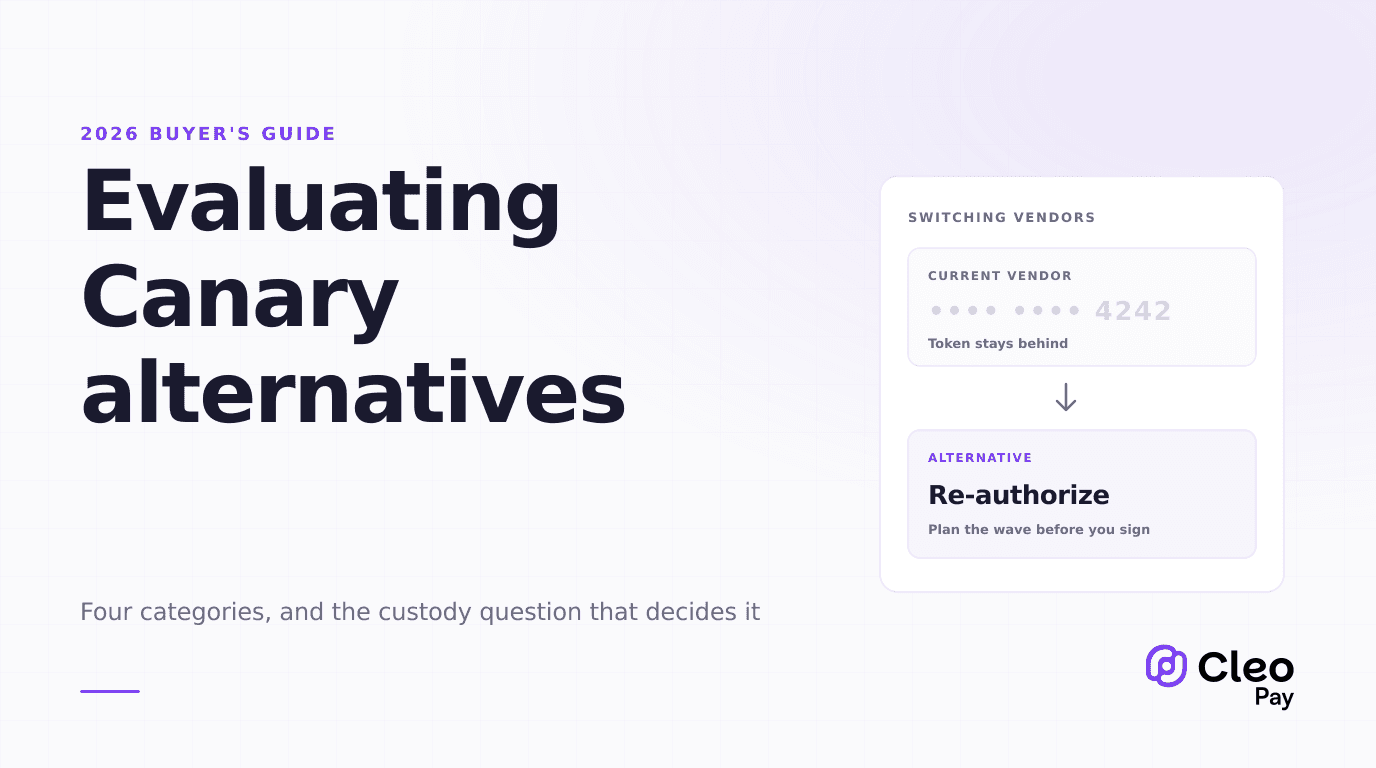
The item that surprises people is the fourth one. Tokens are generally specific to the vendor that issued them, so a token from your current provider is usually meaningless to the next one. That means a migration typically involves asking clients to re-enter card details, which is a customer-facing event that needs a message, a timeline, and a person who owns it. Teams that discover this after signing end up running the re-authorization wave during their busiest month.
The second surprise is the notice period. Annual contracts with auto-renewal and sixty or ninety day notice windows are common. Check the date before you start evaluating, because discovering it in week three of a migration means paying for both systems for a year.
How to run the demo so it tells you something
Vendor demos are optimized to show a clean path through the product. That is reasonable, and it is also why most demos leave you knowing less than you think. Three requests change what you learn.
Ask them to drive your workflow, not theirs. Bring a real scenario from last month: the repeat client who booked twice, the supplier who came back six weeks later needing a fresh authorization, the group booking where three cards covered one reservation. Watch what the rep does when the scenario does not match the script. The recovery is more informative than the demo.
Ask to see the record view, not the flow. Most demos walk you through capture, which is the part everyone does well. Ask instead to look at a stored record a month later. How much of the card is visible, to whom, and what did the audit log write when the rep opened it? This one screen answers several of the criteria above at once.
Ask what the tenth person sees. Demos are given from an administrator account. Ask them to log in as a seasonal front-desk hire or a junior advisor and repeat the same steps. Permission models that look tidy at the admin level sometimes turn out to be one role with everything switched on.
Then ask the exit question directly: if we leave in eighteen months, what do we get, in what format, and what does it cost? A vendor who has thought about this answers plainly. A vendor who has not will tell you that customers do not usually leave, which is not an answer to the question you asked.
Red flags during evaluation
The vendor answers a custody question with an encryption answer. You asked where the card lives. Encryption strength describes how it is protected, not who holds it. The substitution is usually not accidental.
Security claims with no specifics. Phrases that sound reassuring but assert nothing verifiable should be treated as marketing copy, not as evidence.
No clear export path. If the vendor cannot describe what leaving looks like, you are evaluating a one-way door.
Per-user pricing paired with a security recommendation for individual accounts. The vendor is charging you to follow their own advice.
Full card numbers visible to every logged-in user. Discussed above, and the fastest single thing to check in a demo. Ask them to show you the record view.
A roadmap answer to a current-requirement question. If the capability you need most is scheduled rather than shipped, evaluate the product that exists today.
Frequently asked questions
The short version
If you are a property using most of a guest-journey suite, the honest recommendation is to stay and negotiate. Switching costs are real, the bundle is the product, and a competing quote will do more for you than a migration will.
If you use one module out of six, look at the authorization and payment specialists. If disputes rather than collection are what hurt, look at the operations-tied tools. And if you are an agency holding client cards and sending them to suppliers, you have been shopping in the wrong category, which is usually why nothing has quite fit.
Whichever direction you go, decide it on custody rather than on feature counts. Ask where the card lives, ask what you are expected to store, and ask what leaving looks like. Those three answers predict more about how the next two years go than anything else on the comparison grid. For the storage question specifically, our client card storage buyer's guide covers the evaluation in more depth, and our guide to payment fraud prevention covers the controls that sit alongside it.
Want to see what the agency-side workflow looks like against one of your real bookings? We will map your current card process, show you where the scope actually sits, and walk through what migration would involve. Book a walkthrough, or read more about how this works for travel agencies and hotels.