
Most host agencies solve the client-facing side of the business first. There is a CRM, a booking flow, a way to take a deposit, and eventually a real answer for storing client cards. The advisor-facing side tends to get solved last, and it usually gets solved in a spreadsheet.
That spreadsheet works at ten advisors. At forty it starts producing the same three questions every month: which supplier payments actually landed, which bookings they covered, and what each advisor is owed after their split. At a hundred, January arrives and somebody reconstructs a year of payouts into 1099s from bank exports.
This guide covers why commission payouts behave differently from accounts payable, the tax layer that changed for 2026, the four categories of tools available, and what to test in a demo.
Why commission payouts are not accounts payable
Nearly every general business payments tool is built around one shape: a vendor sends you an invoice, somebody approves it, you pay it. That shape is the reason generic accounts payable software struggles here, because a host agency commission payout has none of those three steps.
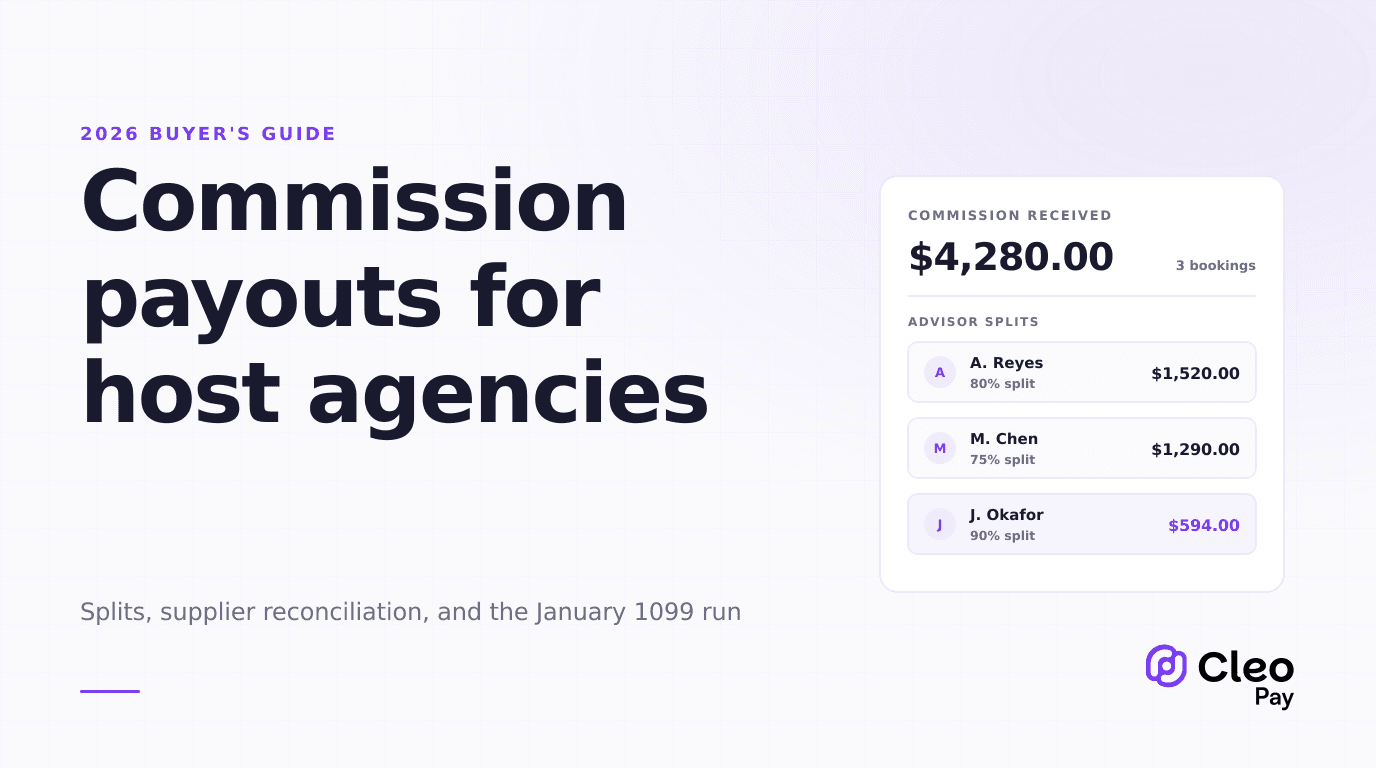
The advisor does not send an invoice. The supplier does not send an invoice either; the supplier sends money, often a consolidated payment covering dozens of bookings across many advisors. The amount owed to any given advisor is not a number anyone stated, it is a number your system has to derive from the commission received and the advisor's split.
So the job is not "pay this invoice." The job is "figure out what we were paid, figure out what share of it belongs to each advisor, then pay that." Tools designed for the first job can be made to do the second, but the derivation happens somewhere outside the tool, which is exactly where the spreadsheet lives.
In accounts payable, the amount owed arrives with the request to pay it. In commission payouts, the amount owed is something you have to compute before anyone can be paid at all.
What actually breaks in a host agency payout run
Four specific mechanics cause most of the pain, and they are worth naming precisely because they are the things you should test a vendor against.
Suppliers pay in lumps, not per booking
A cruise line or tour operator settles on its own schedule and frequently sends one payment covering many bookings. Before you can pay anyone, that lump has to be allocated back to individual bookings. This allocation step is the single most common reason agencies keep a parallel spreadsheet: the CRM knows the bookings, the bank knows the deposit, and nothing connects them automatically.
The split is derived, and it moves
Host agency splits commonly run from around 70/30 up to 90/10, with some hosts starting new advisors nearer 50/50 and others offering full commission in exchange for a higher flat monthly fee. Many hosts use tiered structures where an advisor's split improves automatically once annual production crosses a threshold.
That tiering is the part software handles badly. A static percentage on an advisor record is easy. A percentage that changed in August because the advisor crossed a production tier, applied correctly to bookings that were made before the change but paid after it, is not.
Money is earned at booking and received after travel
Commission is typically paid by the supplier after the client travels, which can be weeks or months after the booking was made. The host holds nothing in between, because nothing has arrived yet, and advisors understandably want to know where their money is during that gap.
This is why advisor-visible status matters more in travel than in most payout categories. An advisor asking "where is my commission" is usually not asking you to pay faster, they are asking which of three states a booking is in: travel not completed, supplier has not paid, or paid and pending the next payout run. A system that answers that without a human looking it up removes a real support burden.
Cancellations run the ledger backwards
If a client cancels after you have already paid an advisor their share, or a supplier claws back a commission, the advisor's balance goes negative. Handling that gracefully, by netting it against the next payout rather than asking for money back, is table stakes for a travel-specific ledger and completely absent from most general payment tools.
The tax layer that changed for 2026
Independent advisors affiliated with a host agency are contractors, and the host issues them a Form 1099-NEC. Three things about that are different or newly relevant this year.
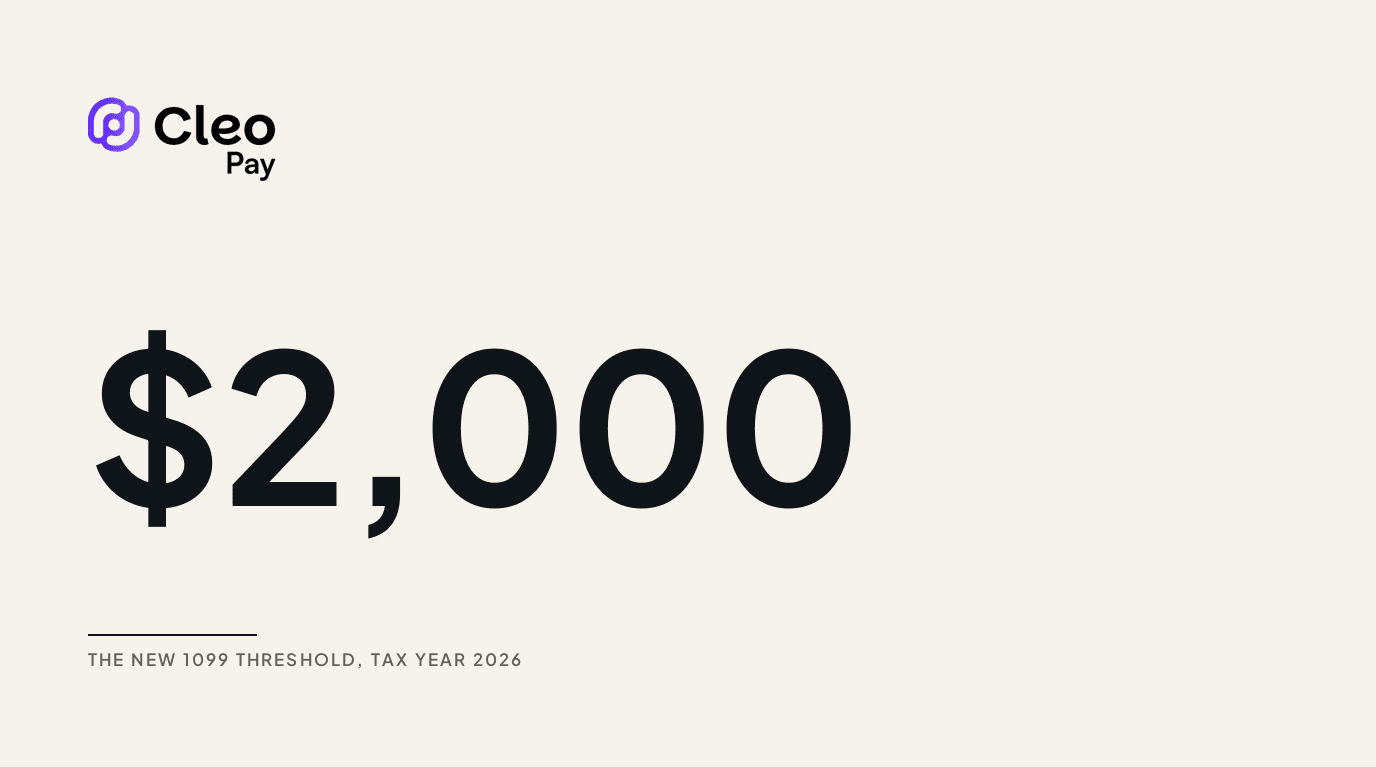
The reporting threshold rose to $2,000. Under the One Big Beautiful Bill Act, signed in July 2025, the reporting threshold for Form 1099-NEC and Form 1099-MISC increased from $600 to $2,000 for payments made on or after January 1, 2026. The threshold is indexed for inflation beginning in 2027. We covered the mechanics of the change in detail in our 1099 threshold guide.
A higher threshold does not mean fewer W-9s. This is the trap. The threshold tells you who must receive a form at year end; it tells you nothing about who you can safely pay without a W-9 today. You cannot know in March which advisors will cross $2,000 by December, and if you have not collected a TIN before the first payment, you are exposed on the withholding side rather than the reporting side.
Backup withholding is unforgiving. If an advisor has not supplied a correct taxpayer identification number, you are required to withhold 24% of the payment. And once you have withheld any federal income tax under the backup withholding rules, you must file a Form 1099-NEC for that advisor regardless of how little you paid them. The $2,000 threshold does not apply. An agency that skipped W-9 collection because "most advisors will not hit the threshold anyway" can end up with more filings, not fewer.
Our W-9 collection guide covers how to make TIN capture part of advisor onboarding rather than a year-end scramble. It is the highest-leverage process change available to a host agency, and it costs nothing.
The evaluation criteria that actually matter
If you are building a scorecard, these are the rows worth having. Vendor feature lists rarely volunteer them.
1. Booking-level commission ledger. Can the system hold an expected commission per booking, then reconcile a lump supplier payment against many bookings? If allocation happens in a spreadsheet, you have not replaced the spreadsheet.
2. Split rules the software computes. Percentage splits by advisor, tier changes with a defined effective date, and correct handling of bookings that straddle a tier change.
3. Tax identity capture at onboarding. W-9 collection with TIN verification, enforced before the first payout rather than requested afterward.
4. 1099-NEC preparation from payout data. Confirm whether e-filing is included or an add-on, and whether the 2026 threshold is handled correctly.
5. Batch payouts with per-advisor status. One run, many advisors, with individual success and failure states rather than an all-or-nothing result.
6. Negative balance handling. Clawbacks and cancellations netted against future payouts automatically.
7. Advisor self-service. Advisors see their own statement and payout history without emailing operations.
8. Pricing that scales on the right axis. Payouts scale with roster size, not with how many staff log in. Per-seat pricing charges you for the wrong thing.
The four categories of tools
Travel CRM and back-office tools. The only category built with commission as a first-class concept. Tools here are designed around importing host statements and allocating commission to individual bookings, which is precisely the reconciliation problem described above. Their limitation is the other half of the job: they are record-keeping systems more than payment systems, and tax form preparation is generally out of scope. Agencies using them still move money and file 1099s somewhere else.
Generic accounts payable platforms. BILL, Melio and similar tools are genuinely good at what they were built for, which is paying vendors against invoices with real approval controls and clean accounting sync. They will move money reliably. What they do not have is any concept of a commission split or a booking-level ledger, so the derivation stays manual, and per-seat subscription pricing plus per-transaction fees means your cost tracks staff headcount rather than payout volume. Our BILL pricing breakdown and Melio alternatives guide have the current cost math if you are comparing inside this category.
Mass payout platforms. Tipalti, Trolley and peers are built for paying large numbers of individuals, with strong tax identity collection and broad international coverage. If a meaningful share of your advisors are outside the US, this category deserves a serious look. The tradeoffs: pricing is typically custom and aimed at higher volumes, implementation is heavier, and like the AP platforms they have no travel commission ledger.
Payments plus back office. Platforms combining payouts with the surrounding operational layer. Cleo Pay's travel agency product sits here, covering advisor payouts, W-9 collection with TIN verification at onboarding, 1099-NEC preparation, approvals with an audit trail, and QuickBooks sync. Published pricing is $55 per seat per month on Starter with 1 seat and 20 payments included at $3 per additional payment, or $75 per seat per month on Growth with 3 seats (from $225) and 100 payments included at $2 per additional payment. The honest tradeoff versus the travel CRMs is the commission ledger itself: this category pairs with your CRM rather than replacing it. Versus the mass payout platforms, it is international breadth.
Payout rails, and what advisors actually care about
- Speed
- 1 to 2 business days
- Cost
- Lowest per payment
- Best for
- Scheduled commission runs on a predictable cycle
- Speed
- Same business day, subject to cut-off times
- Cost
- Premium per payment
- Best for
- Exceptions and corrections, not the default
- Speed
- Days in the mail, plus deposit time
- Cost
- Higher than ACH once handling is counted
- Best for
- Advisors who will not provide bank details
The instinct to buy speed for every payout is usually wrong. A predictable schedule beats a fast one: advisors adapt easily to being paid on the 15th and the last day of the month, and they complain when payouts are fast but erratic. Default to standard ACH on a fixed cycle and keep an expedited option for corrections. Our comparison of same-day and standard ACH covers the cut-off tradeoffs.
Red flags in a demo
Vendors demo the happy path. These are the questions that reveal whether the tool survives your actual month.
Two answers should worry you. If the response to the allocation question involves exporting to a spreadsheet, the tool has not solved your main problem. And if the response to the 1099 question is that the platform gives you a report to hand your accountant, then 1099 preparation is not included, whatever the feature list says.
What agencies underestimate
Advisor onboarding is the whole ballgame. Every downstream problem, failed payments, missing tax forms, backup withholding, traces back to information not collected at the start. An onboarding flow that captures bank details and a verified W-9 before the first booking eliminates most of the January work.
Migration is harder than evaluation. Moving open commission balances, in-flight bookings and historical payout records is real work, and it is easiest between calendar years for tax reasons. If you are evaluating in the autumn, plan the cutover for January 1.
The CRM question is usually settled before the payments question. Most host agencies already have a booking and commission system they are not going to replace. That constraint narrows the shortlist faster than any feature comparison, so establish it first.
The short version
Commission payouts are a different problem from accounts payable, and the difference is that the amount owed has to be computed before it can be paid. Any evaluation that skips the allocation and split question is evaluating the easy half of the job.
Your existing CRM usually decides the category. If it already holds the commission ledger, the gap to fill is payments plus tax identity plus 1099s. If a large share of your roster is international, the mass payout platforms are built for that and the others are not. If supplier reconciliation is the real time sink, fix that before anything else, because paying faster from wrong numbers is not progress.
Whatever you choose, move W-9 collection to advisor onboarding this month. It is free, it takes an afternoon to change, and it removes the single largest source of January work along with your backup withholding exposure.
Want to see advisor payouts, W-9 collection and 1099 preparation working together on your actual roster? Book a walkthrough and bring last year's messiest commission month.