
If you run finance for a restaurant group, a hotel, or a multi-venue hospitality operator, Ottimate has probably come up. It was called Plate IQ until a rebrand, it was built for this industry rather than adapted to it, and the people who use it tend to like it.
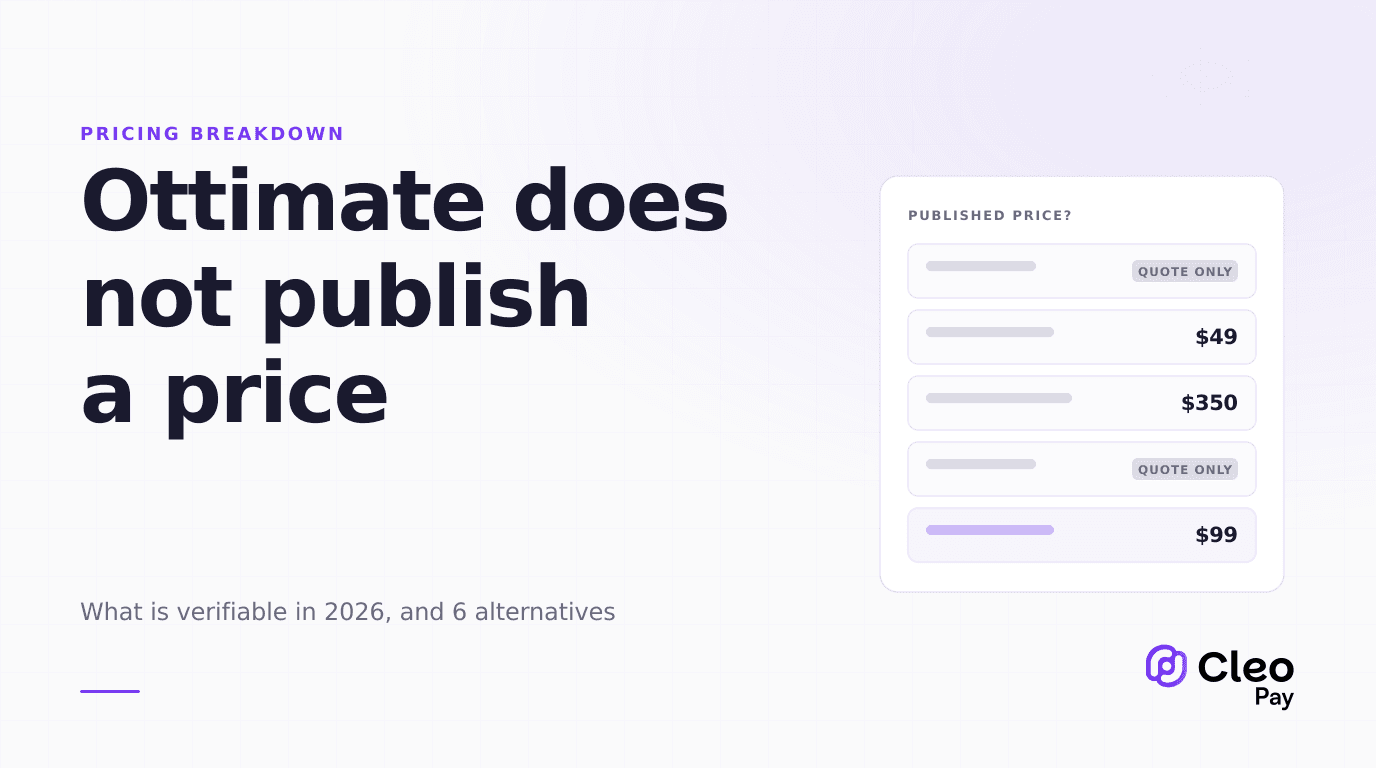
What you cannot do is find out what it costs. Ottimate prices entirely by quote: no public tier list, no per-seat number, no per-location number. That is not unusual in accounts payable automation, but it makes side-by-side comparison genuinely hard, because half the category publishes and half does not.
This guide separates what is verifiable from what is not. It covers what Ottimate is, what moves a quote in this category, the questions that force a comparable number out of a sales process, and six alternatives, with published pricing where it exists.
What Ottimate actually is
Ottimate is an accounts payable automation platform built first for restaurants and hospitality. The core loop is invoice capture, GL coding, approval routing, and payment execution over check, ACH, or virtual card. It syncs to accounting systems and POS platforms, and reviewers on G2 single out the QuickBooks and POS integrations as reliable in daily use.
The industry focus shows up in the customer base. According to GetApp's 2026 listing, hospitality accounts for 26 percent of Ottimate users, restaurants 25 percent, and food and beverage 14 percent. That is roughly two thirds of the user base in one adjacent cluster, and in a category where most vendors are horizontal, that concentration is the product's main argument: the invoice formats, vendor types, and coding conventions are ones it has seen before.
If your problem is that a produce invoice arrives as a photo of a carbon copy and someone keys it into six GL lines, a restaurant-native tool has a real advantage over a general one.
Why there is no price to quote
Ottimate's pricing is fully quote-based, confirmed across independent 2026 listings on both GetApp and Capterra. Neither publishes a starting price because Ottimate does not give them one.
To be fair, Ottimate is not an outlier. Quote-only pricing is closer to the norm than the exception here, and neither AvidXchange nor Stampli publishes a list price either. Vendors argue, not unreasonably, that a ten-location group processing 4,000 invoices a month and a single restaurant processing 90 are not the same customer.
The cost falls on you in two ways. First, you cannot build a shortlist on price: comparing BILL against MarginEdge takes an afternoon because both publish, while comparing either against Ottimate means committing evaluation hours before you know whether the number is in range. Second, a quote is anchored to what you tell them. Describe your peak month rather than your median, and the number moves.
What moves a quote in this category
Four variables do most of the work, and knowing them lets you predict roughly where you will land.
Invoice volume. The biggest driver. Capture and coding is the expensive part to run, so vendors price against it or a proxy for it.
Entity and location count. Eight LLCs with intercompany allocations is a different implementation than eight locations under one entity, and vendors charge for the difference.
Seat count. Even in volume-priced products, approver seats often carry a cost. Count everyone who touches an invoice, including general managers who only approve.
Module mix. Payments, virtual cards, contractor tax reporting, and costing are frequently separate lines. A quote for "AP automation" may not include the piece you came for.
The number a quote-only vendor gives you is a function of what you told them in discovery.
The pricing models you can actually compare
Here is where the published side of the category sits in 2026. Every figure below was checked against current listings, and where sources disagree, that is noted rather than smoothed.
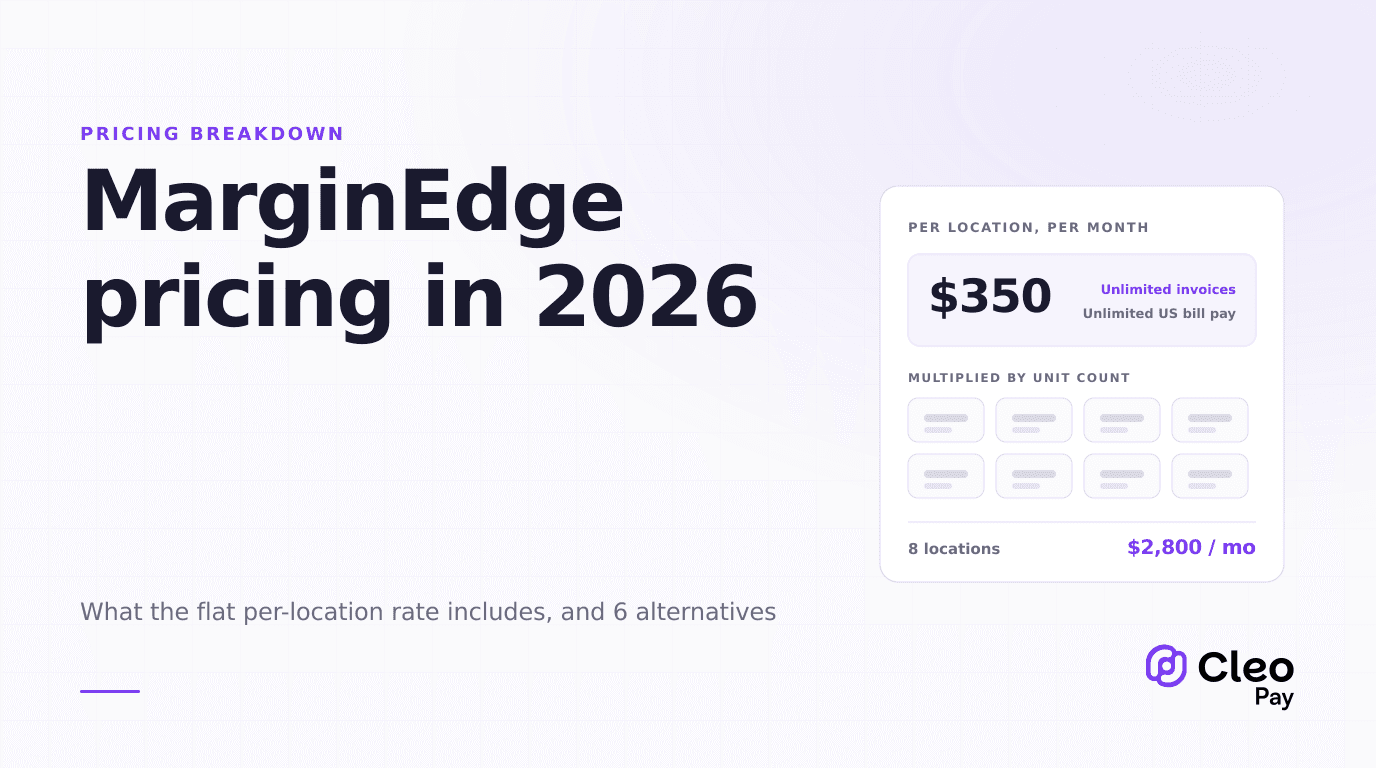
MarginEdge is the clearest published comparison to Ottimate, because it is the other restaurant-native option and it does publish. Its list price is $350 per location per month, with unlimited invoice processing and unlimited US bill payments inside that fee, and annual billing takes roughly 10 percent off. Two costs sit outside the headline: the Freepour liquor inventory add-on brings the total to $500 per location per month, and Toast POS users pay an additional $50 per location per month as a pass-through API fee, which puts a Toast restaurant at $400 rather than $350. More detail is in our MarginEdge pricing breakdown.
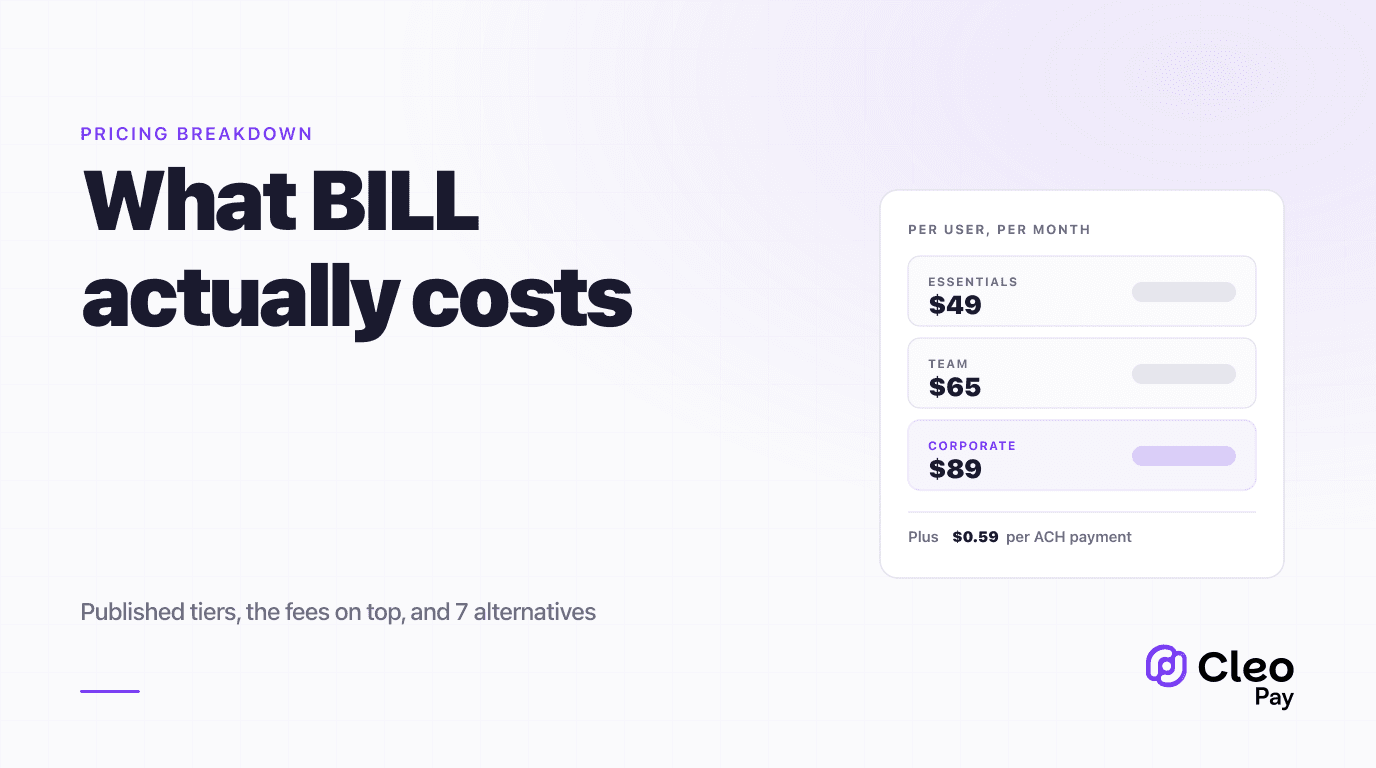
BILL is the clearest comparison on the horizontal side, at $49, $65, and $89 per user per month for Essentials, Team, and Corporate, with a 30-day free trial on Essentials. Per-payment fees are charged separately and vary by rail. We are deliberately not quoting a per-ACH cent figure, because the sources we checked this month disagree on it. Ask BILL directly and get it in writing. The full tier breakdown is in our BILL pricing guide.
Six alternatives, and who each one actually fits
1. MarginEdge
Best for a high-volume restaurant that wants costing and payables in one place. Per-location pricing is strongest when each location processes a lot, because unlimited processing at a flat fee improves the more you push through it. It is weakest with many low-volume locations, where you pay the same $350 for a site doing 40 invoices as for one doing 600.
The honest tradeoff: you are buying an operations platform. If costing is handled elsewhere and you only want payables, you are paying platform prices for a module.
2. BILL
Best for groups whose bottleneck is approval workflow rather than invoice capture, and for mixed-industry operators where hospitality is only part of the business. Published pricing, a large vendor network, and mature accounting integrations make it easy to evaluate and to justify internally.
The honest tradeoff: it is horizontal. It has not seen your distributor's invoice format a thousand times, and per-seat pricing punishes you if a lot of people need to approve.
3. Restaurant365
Best for groups consolidating accounting, operations, inventory, and workforce into one system, usually at the point where a controller spends more time reconciling between tools than closing the books.
A caution on pricing: third-party 2026 listings disagree materially. We found Essential listed at $369 per location per month, and Professional listed at $459, $489, and $635 across three different sources. That spread is too wide to rely on, so treat every published Restaurant365 figure as indicative and get a written quote. Our MarginEdge versus Restaurant365 comparison goes deeper on where the two diverge.
4. Stampli
Best when approvals are the actual problem. Stampli centers communication on the invoice itself, which helps when an invoice sits for a week waiting on a general manager who needs to be asked a question, not sent a reminder.
Pricing is quote-based, same as Ottimate. Third-party estimates put it around $250 to $1,500 per month depending on bill volume and module mix, wide enough to be a starting point rather than a number.
5. Tipalti
Best for operators with cross-border supplier payments, or a large contractor population needing onboarding and tax collection at scale. Third-party comparisons cite a starting price of about $99 per month for its AP product, which would be unusual at the enterprise end of this category. Tipalti does not publish a full rate card, so confirm it on a quote.
The honest tradeoff: a published starting price and a realistic year-one cost are different numbers. Third-party analysis puts real first-year spend for Tipalti and AvidXchange class platforms between $25,000 and $40,000 once implementation is included. That is the shape of enterprise AP procurement rather than a knock on the products, but know it before you budget off a starting price.
6. Cleo Pay
We build Cleo Pay, so read this with that in mind. It is a payments-first platform for hospitality: vendor payments, approvals, AI invoice coding, one-link vendor onboarding, and W-9 collection, with published pricing. Starter is $79 per month billed yearly ($99 monthly) for 2 seats and 20 payments, with additional payments at $3 each. Growth is $239 per month billed yearly ($299 monthly) for 5 seats and 100 payments, then $2 each. Max is $399 per month billed yearly ($499 monthly) for 15 seats and 300 payments, then $1 each. Groups with several venues or entities go on a Custom plan.
The honest tradeoff: we are not an inventory or recipe costing system. If you need theoretical versus actual food cost variance, MarginEdge or Restaurant365 is the better purchase and we will say so on a call. We fit when payables, vendor onboarding, and contractor tax reporting are the part of the month that hurts.
The payment rails question
Whichever tool you pick, the per-payment side of the bill is driven by which rails you use. Ottimate supports check, ACH, and virtual card. Most of this category supports the same set and charges differently for each.
- Speed
- 1 to 3 business days
- Cost
- Lowest per payment
- Best for
- Invoices on normal terms
- Speed
- Same business day, cutoff applies
- Cost
- Premium per payment
- Best for
- Missed due dates and COD releases
- Speed
- Immediate authorization
- Cost
- Percentage of spend
- Best for
- Vendors who accept card without surcharge
- Speed
- 5 to 10 days including mail
- Cost
- Cheap to send, costly to handle
- Best for
- Vendors who will not switch
Pull your last three months of payments and count them by rail before any demo. A quote built on the assumption that most of your spend moves by standard ACH looks very different from your actual bill if a third of it goes out same-day or by card. Our breakdown of same-day versus standard ACH covers when the premium is worth paying.
How to choose
Before you take the call
A quote-only vendor is not a problem to avoid, it is a process to run properly, and the difference between a useful quote and an unusable one is mostly in what you bring to discovery.
The last item catches more buyers than the rest combined. A quote at your current size and a quote at your planned size are different decisions, and the second is the one you are making. Ask for both, in the same document.
Frequently asked questions
The short version
Ottimate is a credible, industry-native accounts payable platform with a user base concentrated exactly where hospitality finance teams live, and reviewers who generally think the price matches the scope. The problem is not the product. It is that you cannot compare it to anything until you have spent time in a sales process, and that cost is real when you are evaluating four vendors at once.
So run the process deliberately. Bring your median invoice volume, your payment mix by rail, your entity list, and your real seat count. Get subscription, transaction fees, and implementation as three separate written numbers. Then convert every quote, published tiers included, into cost per invoice processed and compare on that.
If costing is your constraint, buy the operations platform. If approvals are, buy the workflow tool. If what hurts is paying vendors, onboarding them, and getting through January without a fire drill, that is narrower than a platform purchase and should cost less than one.
Cleo Pay publishes its pricing, sizes plans by payments and seats rather than by location, and is built for restaurants, hotels, and event operators. We will also tell you plainly when a costing platform fits you better. Get started or see how it works.