
A venue does not send one invoice per booking. It sends three or four, spread across a calendar that can run eighteen months from signature to load-out. There is a deposit to hold the date, usually a second payment somewhere in the middle, a final balance due before doors, and then whatever settles afterward once the bar count and the damage walkthrough are done.
Most invoicing software is built for the opposite shape: one invoice, one payment, thirty-day terms, a few hundred dollars. Run a venue's booking schedule through a tool built on that assumption and two things go wrong. The payment schedule becomes something a coordinator tracks by hand in a spreadsheet parallel to the software, and the processing fee, which nobody notices on a $400 invoice, starts costing real money on a $9,000 deposit.
This guide covers why venue receivables behave differently, what the fee structures actually cost across a season, the four categories of tools available in 2026, and what to test before you sign.
Why venue receivables are not freelancer receivables
The generic invoicing category was built around a service business billing for completed work. Someone does the job, sends an invoice, waits to be paid. Almost every feature follows from that sequence: due dates counted from the send date, overdue reminders, aging reports bucketed at 30, 60 and 90 days.
A venue booking inverts nearly all of it. The money arrives before the work, not after. The deposit is not a partial payment against an overdue balance, it is the thing that makes the booking real, and the date is not held until it clears. The final balance is typically due days before the event rather than weeks after, so a late payment is not a collections problem, it is an operational decision about whether the event happens.
Three consequences follow, and they are worth testing any tool against.
The schedule is the record, not the invoice. A venue needs to see, per booking, what has been invoiced, what has been collected, and what is still outstanding against a contract total. Tools that model each invoice as an independent document force somebody to keep that reconciliation somewhere else.
Amounts are large, so the rate structure dominates. A percentage fee that is invisible in freelance invoicing becomes one of the larger line items in a venue's cost of doing business. More on the arithmetic below.
Money moves in both directions. The same event that generates a deposit also generates payouts to performers, caterers, security, and production. A tool that solves only the incoming half leaves the other half in a different system, which is where the event P&L stops closing on time.
What the fee structure actually costs
This is the part most comparisons skip, and for a venue it usually decides the answer.
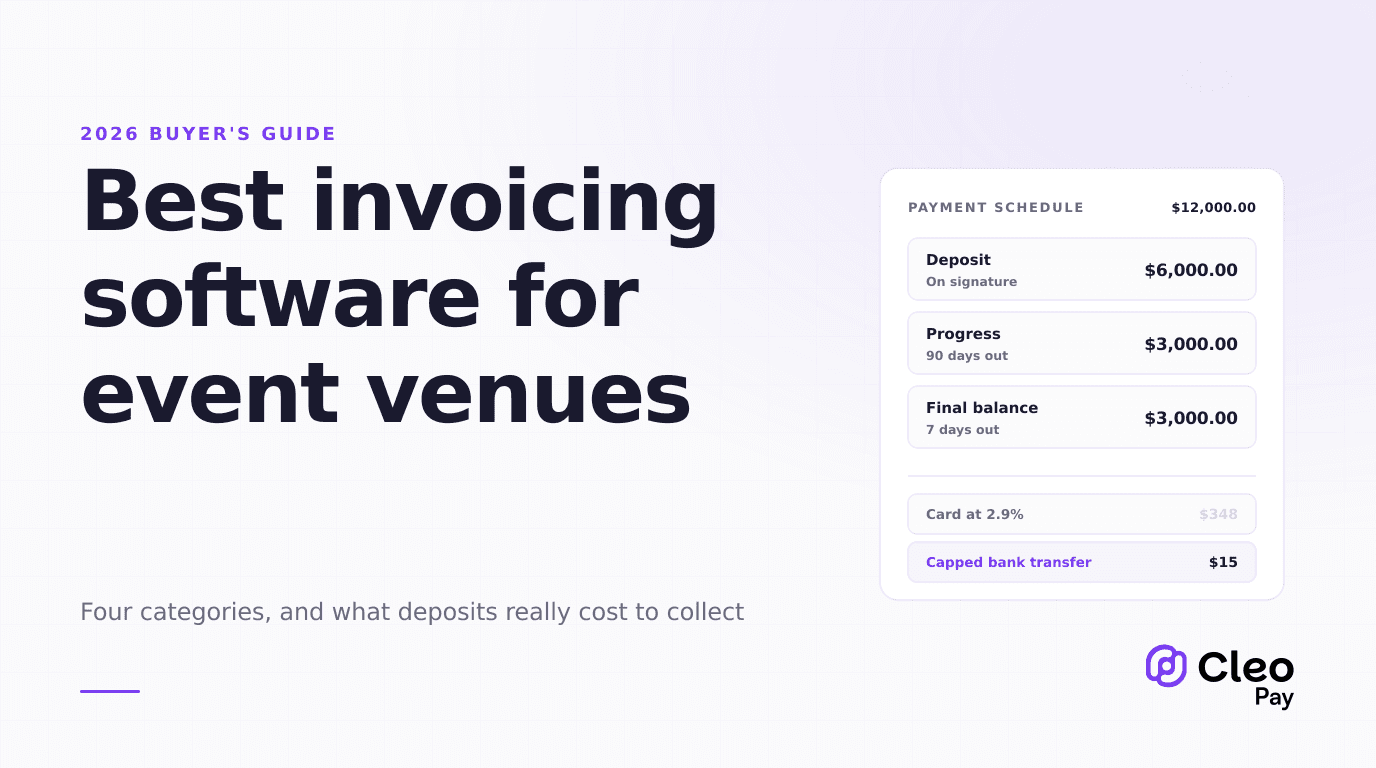
Card processing is charged as a percentage of the full amount, and the standard published US rate is 2.9% plus $0.30 per transaction. ACH bank debit is charged differently. On Stripe's published US pricing, ACH Direct Debit runs 0.8% with a $5 cap, which means the cap is reached at $625 and every payment above that figure costs a flat $5 regardless of size.
Work that through a single mid-size booking. Take a $12,000 event billed as a 50% deposit, a $3,000 progress payment, and a $3,000 final balance. Paid by card at the standard rate, the three payments cost roughly $174, $87 and $87, so about $348 on one booking. The same three payments over capped ACH cost $5 each, or $15.
Extend it across a season. A venue running two events a week at that average books a little over 100 events a year, so the card route costs somewhere near $35,000 annually in processing and the capped ACH route about $1,500. Those figures are arithmetic from the published rates and stated assumptions above, not measured results, and your own mix will differ. The point is the order of magnitude: on venue-sized amounts the choice of rail is not a rounding difference, it is a line item worth more than most of the software.
On a $400 invoice the processing rate is a rounding error. On a $9,000 deposit it is a decision about margin.
Two caveats keep this honest. Clients often want to pay by card, sometimes for points and sometimes because a corporate card is the only instrument they have, so no venue gets to 100% ACH. And platforms that bundle client management with payments frequently charge their own processing rate on top of a subscription, which is why the published plan price is only half of what a platform costs you.
The four categories of tools
Nearly everything sold to venues falls into one of four groups. They are not ranked, because the right answer depends on which problem is actually costing you.
1. General invoicing and accounting tools
QuickBooks, Wave, Stripe Invoicing, and the invoicing built into most small business accounting packages. These are inexpensive, familiar to whoever does your books, and they integrate with everything.
What they do well is produce a clean invoice and land the transaction in the ledger without a second entry. What they do poorly is the payment schedule. Deposits and progress billing usually get modelled as separate unlinked invoices or as a running credit, and neither gives a coordinator a per-booking view of what is still owed. For a venue doing a handful of events a month this is survivable. At volume it is the thing that pushes the real record back into a spreadsheet.
2. Client-management platforms for creative and event businesses
HoneyBook, Dubsado, Bonsai, Plutio, and similar tools. These cover the full client lifecycle: inquiry, proposal, contract with e-signature, invoice, payment, and the client portal that ties them together. For a venue whose sales process is genuinely relationship-driven, having the signed contract sitting next to the payment schedule is a real advantage.
The tradeoffs are pricing and fit. HoneyBook's published tiers run $36, $59 and $129 a month, and the platform raised prices substantially in February 2025, with the entry tier moving from $19 to $36. Processing sits on top of the subscription. These platforms are also built primarily for a solo operator or small creative team rather than a venue with a floor manager, a events coordinator, and a bookkeeper who all need different access.
3. Venue and event management suites
Event Temple, Planning Pod, Tripleseat, Perfect Venue, and the hospitality-specific platforms. These start from the booking rather than the invoice: room and space inventory, availability calendars, banquet event orders, function sheets, and the sales pipeline that fills the calendar.
Billing is present but it is usually a module rather than the core, and the payment rails behind it are often a generic processor at standard card rates. Planning Pod prices by event count rather than per user, which fits a venue's shape better than seat-based pricing does. These suites are the strongest option if your bottleneck is filling and running the calendar. They are the weakest if your bottleneck is the money moving in and out.
4. Hospitality payment platforms covering both directions
Tools built around the payments themselves rather than around the document or the calendar, handling receivables and payables in one place. This is the category Cleo Pay sits in, and the honest description of the tradeoff is that you gain the payment rails and the both-directions view, and you give up the deep event-operations features that a dedicated venue suite has spent a decade building.
Cleo Pay's published plans are Get Paid at $0 for vendors and contractors receiving payments, Basic at $99 a month, Plus at $199 a month for 50 payments with next-day ACH, automated 1099 filing and 3 team seats, and Pro at $299 a month for 100 payments with 10 seats. On the receivables side, bank payments carry no processing fee and cards are 2.9%. Full detail is on the pricing page.
Which category fits your venue
What to test in a demo
Vendor demos default to the happy path: one invoice, one client, one payment. Ask for the awkward cases instead, because those are the ones your season is made of.
The refund question is worth dwelling on. Percentage processing fees are frequently not returned when you refund a payment, which means a cancelled booking on a card can cost the venue a few hundred dollars for money it never kept. Ask directly and get the answer in writing.
The payment rails behind the invoice
Whatever the interface looks like, the money moves over one of a small number of rails, and they differ in speed and cost. For venues the relevant question is usually whether a final balance paid two days before an event will actually be settled before doors.
- Speed
- 1 to 3 business days
- Cost
- Lowest, often capped or free
- Best for
- Deposits and progress payments booked well ahead of the event
- Speed
- Next business day
- Cost
- Low, sometimes plan-dependent
- Best for
- Final balances due in the week before an event
- Speed
- Same business day, cutoff bound
- Cost
- Higher per-payment fee
- Best for
- Late balances and last-minute additions
- Speed
- Immediate authorisation
- Cost
- Percentage of full amount, uncapped
- Best for
- Clients who require a card, and small add-ons
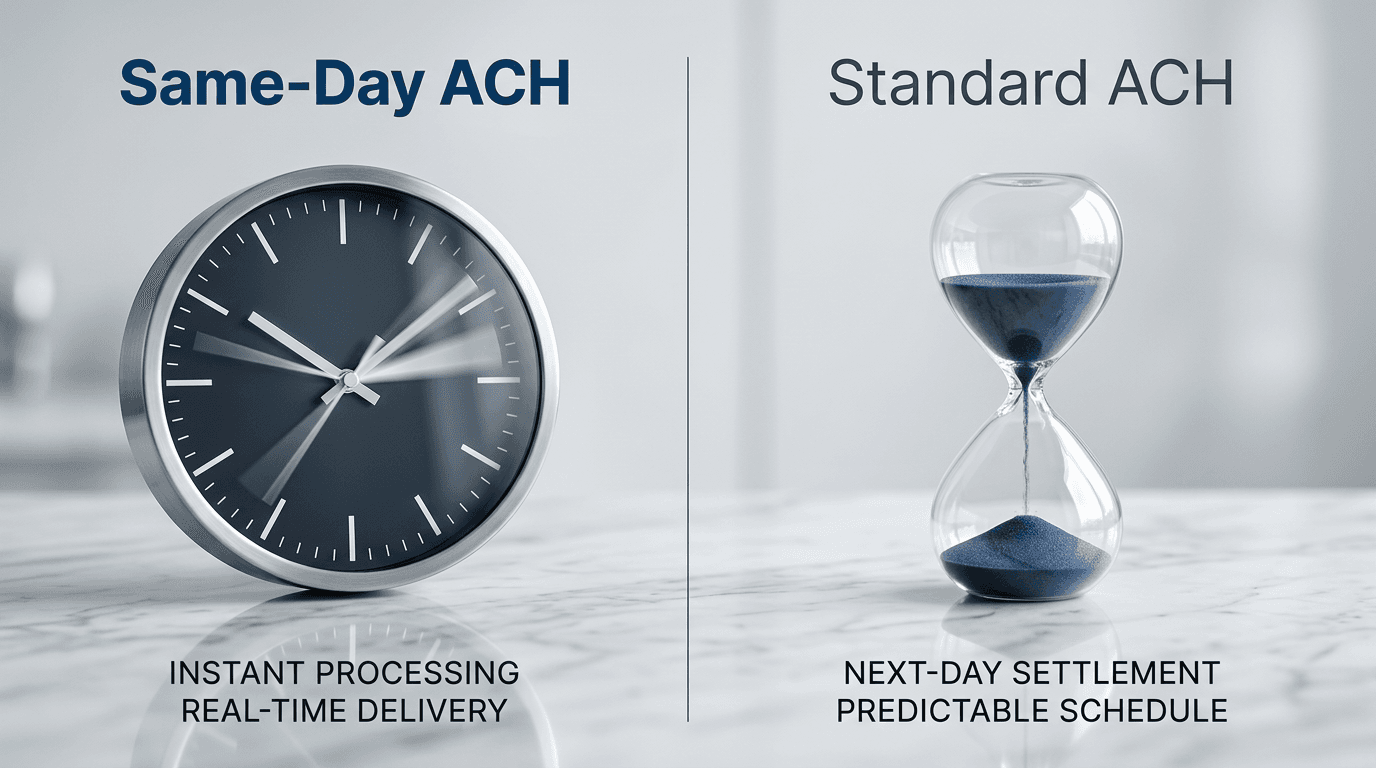
The cutoff times matter more than the marketing names. A same-day rail with an early afternoon cutoff is a next-day rail for anything that arrives at five o'clock. We covered the operational differences in more detail in same-day ACH versus standard ACH.
The half of the problem that is not invoicing
A venue's event does not end when the client's final balance clears. The same event generates payments out: the headliner or the band, the caterer, security, production, cleaning, and whatever independent staff worked the door. Those payouts are what turn an invoicing decision into a payments decision.
They also carry a tax layer that changed this year. The Form 1099-NEC reporting threshold rose from $600 to $2,000 for payments made in 2026 under the One Big Beautiful Bill Act, and it is indexed for inflation starting with 2027 payments. The backup withholding trigger moved in step with it, and the withholding rate remains 24% where a payee has not supplied a correct TIN.
For venues booking the same performers repeatedly across a season, that cumulative total arrives faster than people expect. Four nights at $600 is past the threshold. We wrote about the change in detail in the 1099 threshold increase for 2026, and the payables side of the same question for catering and event businesses in the bill pay buyer's guide for catering and event companies.
Pricing models, and what they hide
Four pricing shapes are common, and each hides a different cost.
Per seat. Cheap for an owner-operator, expensive the moment a coordinator, a bookkeeper and a floor manager all need access. Venues tend to have more people needing read access than the model assumes.
Per event. Fits a venue's shape well, since cost scales with the thing that generates revenue. Check what counts as an event and whether a cancellation still consumes one.
Per payment. Predictable and easy to model. Check the included allowance and the overage rate, since a busy season can run well past the plan's monthly count.
Percentage of volume. The most dangerous for venues, because cost scales with deposit size rather than work performed. A platform taking a percentage on a $15,000 deposit is charging for a transaction that costs it the same as a $150 one.
The number that matters is total annual cost at your real volume: subscription, plus per-payment or per-event charges, plus processing on your actual mix of card and bank payments. Build that figure for two or three candidates before you look at any feature list, because it frequently reorders the shortlist.
Frequently asked questions
Where to start
Most venues do not need to replace everything at once. Price your real last-season volume against two or three candidates, fix the rail your deposits arrive on first because that is where the money is, and only then decide whether the calendar and contract features justify a second system.
If the both-directions problem is the one costing you, deposits arriving in one place and payouts leaving from another, that is the case for consolidating. If your calendar is the bottleneck, a venue suite will serve you better than anything in this guide's fourth category, and that is a fair answer to reach.
Want to see deposits arriving and performer payouts leaving in the same place, priced against your own season? Book a walkthrough and bring last year's busiest month.
Ready to simplify your AP workflow?
Get early access to Cleo Pay and see how we help hospitality teams save hours every week.