
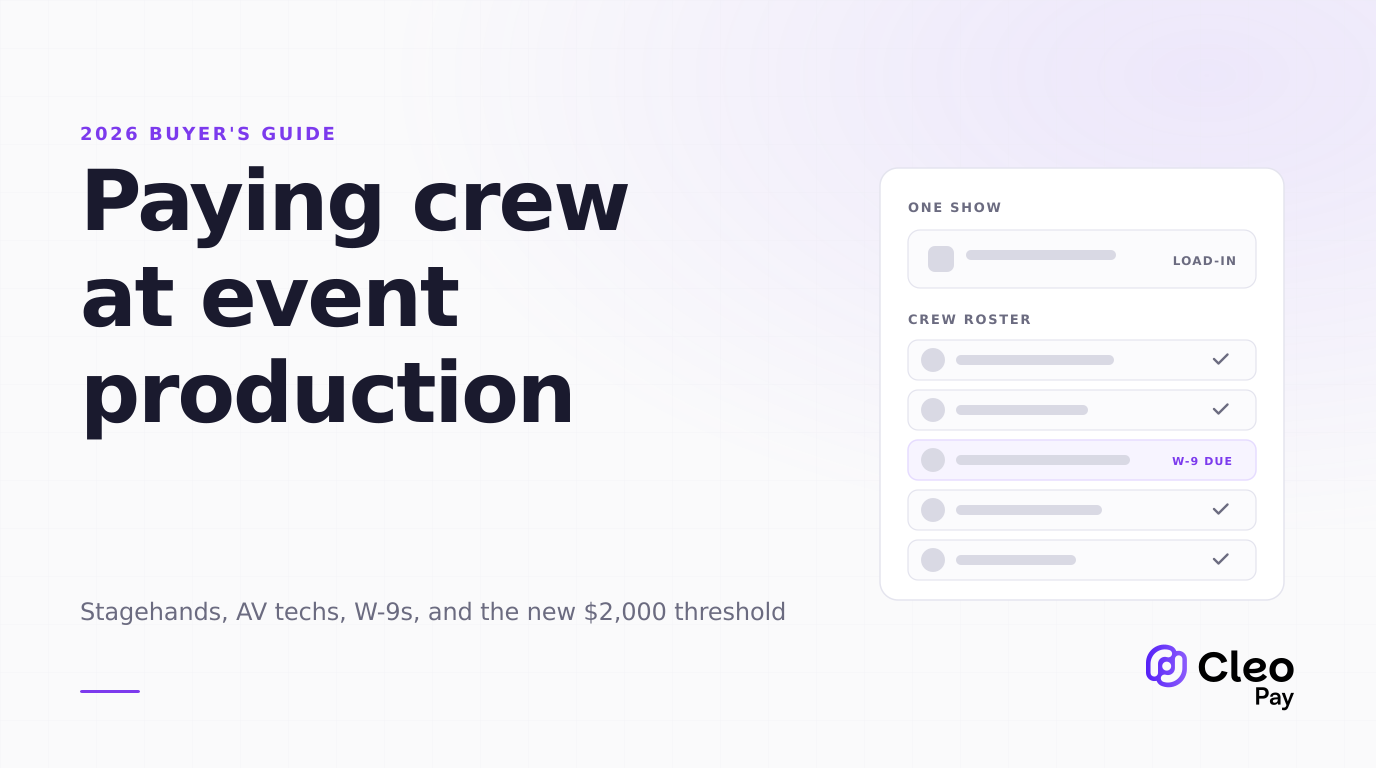
An event production company pays more people in a weekend than most businesses pay in a quarter. A single mid-size show can involve a load-in crew of twelve, four audio and lighting techs, two camera operators, a forklift operator, a rigger, six deck hands on the strike, a runner, and a production manager, and almost none of them will be on the next show. The roster resets every time. The paperwork does not.
That is the shape of the problem, and it is why so much of the advice about paying contractors misses for this industry. Guides written for agencies assume a stable bench of ten freelancers. Guides written for film assume a signatory production with a payroll company already attached. Live events sit in between: high headcount, short engagements, fast payment expectations, and a roster that churns almost completely between jobs.
This guide covers what contractor payment software actually has to do for a production company, the four categories of tool that compete for the job, what they cost as of September 2026, and the compliance change that quietly reshaped this year's 1099 season.
Why crew payments break generic tools
Most payment software assumes the payee list is roughly stable and that onboarding is a one-time cost amortized over years of work. Live event production violates both assumptions on every show.
Onboarding is the recurring cost, not the exception. If collecting a W-9, bank details, and a signed engagement letter takes fifteen minutes of back-and-forth per person, a forty-person show costs ten hours of coordinator time before anyone is paid. The predictable result is that crew get paid first and the paperwork gets chased in January, which is exactly the sequence that creates problems.
The payee is sometimes a person and sometimes a company. The same lighting designer might invoice as a sole proprietor on one show and through an S-corp on the next. A rigging vendor sends a company invoice. A local stagehand wants a personal payment. Tools built purely for payroll handle the first case and fumble the second; tools built purely for vendor AP do the reverse.
Crew expect to be paid in days. Net-30 is a vendor convention. A deck hand who worked a Saturday strike until 3am expects money that week, and the crews who get paid fastest are the ones who answer the phone next time. Any tool whose only rail is standard ACH pushes you back toward writing checks to keep people happy.
Costs have to land on a show, not a month. A production company's real unit of account is the job. If the software cannot tag twenty-two contractor payments, a generator rental, and a trucking invoice to "Riverfront Festival, August 14 to 16," you cannot tell which shows made money. We wrote about closing that loop faster in closing an event P&L.
Union and non-union work coexist. Many production companies run non-union corporate and festival work alongside occasional union calls. A tool that only handles one is a partial answer, and pretending otherwise during evaluation is how companies end up running two systems.
The deciding question is not which tool files the best 1099. It is which system already holds a validated W-9 and the complete payment record for every person who worked your shows.
The evaluation criteria that actually matter
Score these, weighted roughly in this order. The surface features tend to be similar across vendors; these are where they diverge.
Time to onboard one new crew member
Measure it in a demo with a stopwatch. Ask the vendor to add a brand new contractor, collect a W-9, capture bank details, and get them payment-ready. Anything over about three minutes of your staff's time, as opposed to the contractor's own time on their phone, multiplies painfully across a season. The best implementations push the work to the contractor through a link and require nothing from your coordinator but an email address.
Whether the system holds the full-year payment record
This is the criterion that decides January. A filing tool that receives a spreadsheet you assembled by hand from a bank, a payroll product, and a peer-to-peer app is a form generator, not a compliance system. If crew payments run through one system all year, filing is a review task. If they do not, no software repairs it.
W-9 capture before first payment, and TIN validation
Capturing the W-9 at onboarding rather than chasing it later is the single highest-leverage habit in this vertical. Validating the name and TIN combination against IRS records is the second. Both are free to do and neither happens by accident. Our W-9 collection guide covers the mechanics.
Payment speed, and what fast costs
Ask for the specific rails, the cutoff times, and the fee for each. Standard ACH is cheap and slow. Faster rails exist at every vendor and are priced differently at each. The mistake is budgeting for the subscription and discovering the per-payment fees on the first show.
Job or event coding
Can a payment be tagged to a show at the moment it is created, by the coordinator who knows which show it was, rather than reconstructed by a bookkeeper three weeks later? If coding is a downstream accounting task, it will be wrong.
Handling both contractors and vendors
A production company pays crew and it pays trucking companies, equipment houses, venues, and caterers. Running two systems doubles the reconciliation work and guarantees that no single system knows a payee's full-year total. Our catering and event company bill pay guide covers the vendor side of the same problem in more depth.
The four categories, and where each fits
Entertainment payroll is the most capable option and the one built explicitly for this world. Wrapbook, Cast & Crew, GreenSlate and The TEAM Companies handle union agreements, loan-out corporations, timecards, and workers compensation in ways general tools do not attempt. Wrapbook advertises no monthly, annual, or tech fees and instead charges a processing fee on payments run through the system, quoted per production, with access free for the workers themselves. The tradeoff is real: this category is designed around productions with budgets and payroll volume to match, it is quote-based rather than transparently priced, and it generally does not want to pay your trucking vendor or your venue deposit. If a meaningful share of your work is union, start here anyway.
Contractor payroll platforms are the cheapest transparent option. Gusto's Contractor Only plan is $35 per month plus $6 per contractor per month, with a promotion that has been waiving the base fee. At a steady bench of eight freelancers that is inexpensive and perfectly adequate. The arithmetic changes at event scale: a company touching 150 distinct contractors across a season is paying per-contractor fees for people who worked one show, and the platform still will not pay the generator rental. These tools also have no concept of a show.
General AP platforms handle the vendor half well. BILL publishes Essentials at $49, Team at $65, and Corporate at $89 per user per month, with ACH at $0.59 and a mailed check at $1.99. Per-user pricing is worth modelling honestly, because production companies tend to want several coordinators in the system, and the per-user line is what surprises people rather than the transaction fees. The gap is contractor onboarding and 1099 work, which these platforms treat as an adjacent feature rather than the main event.
AP platforms built for event businesses try to collapse the split by treating a contractor and a vendor as the same kind of payee with the same onboarding path and the same full-year record. Cleo Pay sits here: vendors and contractors are paid free on the Get Paid side, Basic is $99 per month, and Pro is $299 per month with 100 payments included, 1099 filing, and dedicated support. The honest limitation is the same one the rest of this category shares: it is not a union payroll system, and if you are running signatory calls with loan-outs and timecards, entertainment payroll is the right tool.
The $2,000 threshold changed more than it looks
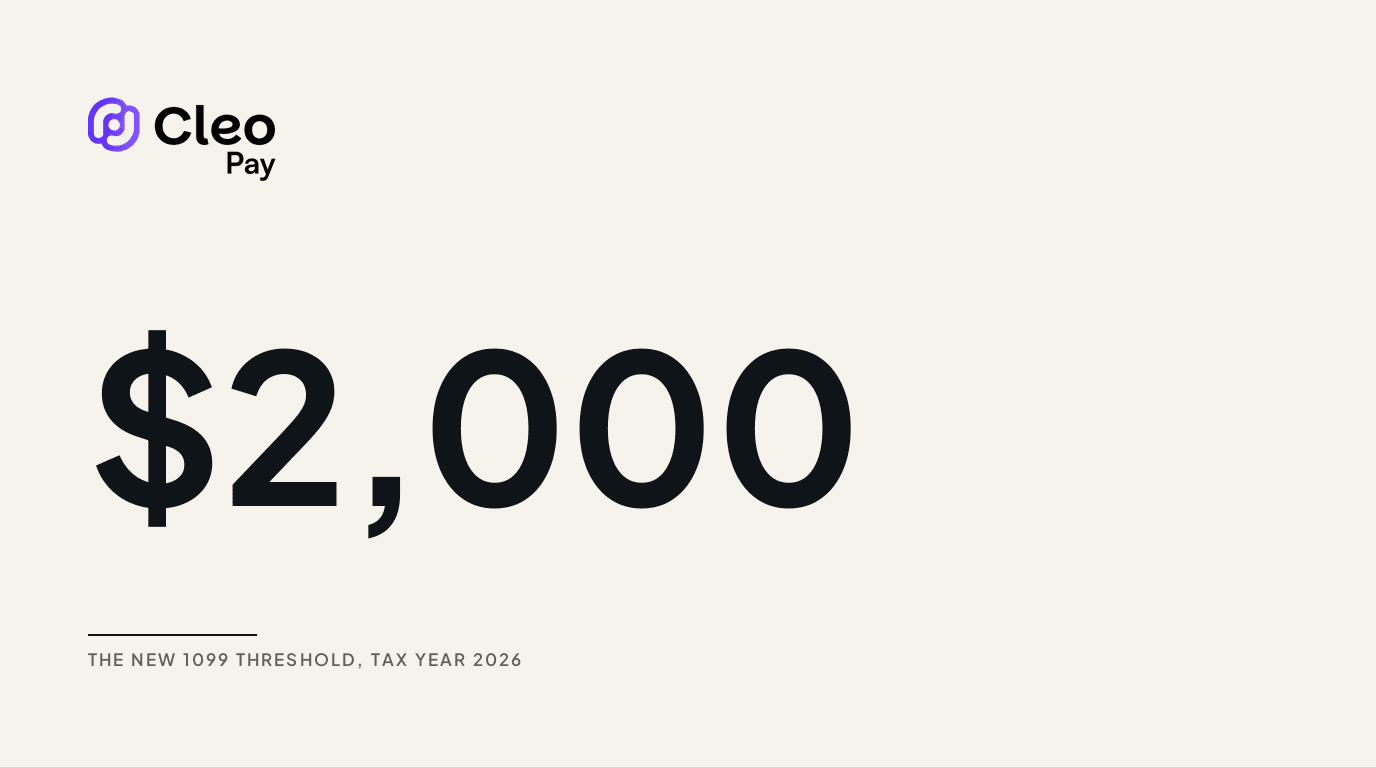
For payments made on and after January 1, 2026, the One Big Beautiful Bill Act raised the Form 1099-NEC reporting threshold from $600 to $2,000. The threshold is indexed for inflation beginning with payments made in 2027, using 2025 as the base year and rounding to the nearest $100.
For event production, this is a bigger shift than for almost any other industry, because so much of a production company's roster sits in exactly the band that just dropped out of reporting. A stagehand who worked four shows at $450 a day is no longer getting a form. A camera operator who worked one festival is not either.
There is a second trap. State reporting thresholds did not automatically follow the federal move, and several states maintain their own lower thresholds and their own filing requirements. If you run shows in multiple states, confirm each state's rules rather than assuming $2,000 applies everywhere.
Backup withholding is the expensive version of a missing W-9
If a payee never furnishes a TIN, or furnishes one that is obviously invalid, the payer is required to withhold 24 percent of reportable payments and remit it, reporting the amounts on Form 945. Withholding begins on the first payment, not after some grace period. A payer who was required to withhold and did not can be liable for the withholding amount itself, plus penalties and interest.
In practice this is the strongest argument for capturing the W-9 before the first payment rather than after the show. A load-in crew hired on Thursday for a Saturday call is precisely the situation where the paperwork gets skipped, and the exposure sits with the production company rather than the crew member. We covered the threshold change in more detail in the 2026 1099 threshold increase.
Payment rails and what they cost you
- Speed
- Typically one to three business days
- Cost
- Lowest per payment at most vendors
- Best for
- Vendors on terms, crew paid on a predictable weekly cycle
- Speed
- Same day or next day, subject to cutoffs
- Cost
- Materially higher per payment
- Best for
- Day-of crew and post-strike payments
- Speed
- Days in transit, plus deposit time
- Cost
- Per check, plus the staff time nobody counts
- Best for
- Payees who will not share bank details
- Speed
- Depends on the rail chosen
- Cost
- Bundled up to an allowance, then per payment
- Best for
- High payment counts where per-item fees compound
Model this against your real show calendar rather than an average month. A production company doing four festivals in August and two corporate gigs in February has a payment count that swings by an order of magnitude. Per-payment pricing punishes the peak; per-user pricing punishes the team size; flat plans with allowances punish neither until you exceed the allowance. There is no universally cheaper model, only one that fits your shape better.
Two complications specific to live events
Crew who work in several states
Touring and festival work moves crew across state lines, and the reporting obligations move with them. The federal threshold is uniform; state information reporting is not. Some states participate in the combined federal and state filing program, some require a direct filing, and several kept thresholds below the new federal $2,000. The practical rule is to keep a record of which state each engagement was worked in at the time you book it, because reconstructing that from a payment history in January is guesswork. Any tool that lets you tag a show with a venue and a location gives you that for free; any tool that does not means somebody keeps a spreadsheet.
The same logic applies to how you classify the engagement in the first place. Short, project-based, crew-supplied-their-own-tools work is the classic contractor pattern, but classification is decided by the working relationship rather than by the paperwork, and it varies by state. If a substantial part of your crew works regularly enough to look like staff, that is a conversation with your accountant before it is a software question. Our contractor payroll overview covers where the line usually sits.
Venues and equipment houses are payees too
It is easy to scope this decision around crew and forget that a production company's largest single payments usually go to venues, equipment rental, and trucking. Those payees want invoices, terms, deposits, and sometimes a certificate of insurance attached to the payment. A tool that pays crew beautifully and cannot handle a 50 percent deposit against a rental contract leaves half the job undone, and the half it leaves is the half with the big numbers in it. If you also operate or book rooms, the venues overview covers the payment side of that relationship.
Switching mid-season is usually fine
Production companies often assume they have to wait for a year boundary. In practice the constraint is the 1099 record, not the calendar. If you move crew payments to a new system in September, you will file for 2026 from two sources, which means one export, one merge, and one reconciliation. That is a few hours of work once. Waiting three months to avoid it costs you three months of onboarding and coding you cannot recover, and the busiest part of a production year is often exactly the period you would be waiting through. The one thing worth doing before you switch is exporting a complete year-to-date payment total per payee from the old system while you still have clean access to it.
Red flags during evaluation
The demo starts with a CSV import. Ask where the payee data comes from in the normal case. If the answer is a spreadsheet, you are buying a transmitter and keeping the hard problem.
No clear answer on a failed TIN match. This happens constantly with crew rosters, where the name on a W-9 often differs from the name in your contact list. A vague answer means you handle it by hand every January.
Job coding described as "you can use classes." Ask to see a payment tagged to a show at creation time, by a coordinator, on a phone. If it only works through the accounting integration after the fact, it will not happen during a busy season.
Per-user pricing quoted at one user. Production companies need coordinators, a production manager, and a bookkeeper in the system. Get the quote at the real seat count.
Union capability described without specifics. Ask which agreements, and ask for a reference doing the kind of calls you do.
Before your next show
Frequently asked questions
The short version
For union work, use entertainment payroll. That branch is decided before the rest of the evaluation starts.
For everything else, the choice comes down to how much of your spend is crew versus vendors, and how much your roster churns. A small steady bench of freelancers is well served by a contractor payroll plan at per-contractor pricing. A vendor-heavy operation with occasional crew is well served by a general AP platform, priced at the seat count you actually need. A production company with large churning rosters and heavy vendor spend is the case where running two systems costs the most, because nobody ends the year holding a complete record of any payee.
Whichever you pick, the work that pays off this month is not the software decision. It is pulling a year-to-date total per payee, finding everyone near $2,000, and collecting the W-9s you are missing while those people are still working your shows. That is free, it takes an afternoon, and it removes most of what makes January difficult. If you are also rebuilding how shows get costed, our event P&L guide and the event productions overview are the companion pieces.
Want to see W-9 capture, crew payments, vendor bills, and show-level coding working as one system? Book a walkthrough and bring a crew list from your busiest weekend.